White Cake with Sweet Lemon Frosting

white cake with lemonLast week’s cookie-baking extravaganza left me with six egg yolks, which of course I turned into lemon curd, which I then needed to use up in some creative way. Hence, white cake with lemon curd filling and sweet lemon frosting.

Recipes for single-layer cakes like this one are quite useful, especially if you’re baking for a date night or a small gathering. Tonight, Mike and I will celebrate New Year’s Eve, and this little treat will be perfect for our dessert.

Just a few items to note: my sweet lemon frosting is similar to lemon cream cheese frosting, and it’s based on another lemon frosting recipe I saw recently, with different ratios to increase the sweetness. Appearance-wise, don’t worry if your lemon curd filling and frosting drip over the sides of your cake; this just makes the end result a more charming, old-fashioned-looking dessert.

White Cake

Ingredients

  • 1 1/2 cups flour
  • 1/2 tablespoon baking powder
  • 1 cup sugar
  • 1/4 teaspoon salt
  • 1/4 cup shortening
  • 1 egg
  • 1/2 teaspoon vanilla
  • 3/4 cup milk

Preparation

Preheat oven to 375 degrees. Spray a 9-inch round cake pan with baking spray; line with a parchment circle and spray the parchment.

In a small bowl, combine flour and baking powder; set aside.

In a mixing bowl, cream together sugar, shortening, and salt until fluffy.

Add egg and vanilla; beat until combined.

Add flour mixture and milk in alternating batches, starting and ending with the flour and beating until just combined.

Pour batter into prepared pan; bake for 25 minutes, until top is golden and a cake tester comes out clean.

Cool cake completely before filling and frosting.

Lemon Curd Filling

  • 1 recipe lemon curd, prepared in advance. Reserve about 2 tablespoons prior to filling the cake for the frosting.

Sweet Lemon Frosting

Ingredients

  • 4 tablespoons butter
  • 2 ounces cream cheese
  • 2 tablespoons lemon curd
  • About 2 1/4 cups powdered sugar

Preparation

In a mixing bowl, beat butter and cream cheese until very well blended, about 3 minutes.

Add 1 cup powdered sugar and 1 tablespoon lemon curd; beat on low to begin, then increase speed and beat on medium until well-blended. Add additional cup powdered sugar and additional tablespoon lemon curd; beat on low to begin, then increase speed to medium and beat until very well-blended. Taste; add another 1/4 cup powdered sugar if desired.

To assemble the cake:

Using a very sharp knife, cut cake in half horizontally. Flip top half onto a cake platter top-side down and spread lemon curd in an even layer. Lemon curd will drip over the sides; this is fine.

Top with the remaining cake half and frost the top of the cake only, so you’ll be able to see the sides. Store in the fridge.

Peppermint Pattie Cake

peppermint pattie cakeDark chocolate and peppermint are great friends. Perhaps the most famous product with this combination is the York Peppermint Pattie, another amazing confection pioneered right here in the Commonwealth of Pennsylvania in the 1940s.

This cake tastes much like a York Peppermint Pattie, even though the candies aren’t used in the recipe. Next time, instead of crushing red and white mints for the cake’s garnish, I’d like to cut Peppermint Patties into halves or quarters and place them along the edge of the cake for the border. One other item to note about this recipe: the original recipe that I found online called for 3/4 cup of boiling water to be stirred in by hand once all of the other ingredients were blended. This seemed like far too much liquid to me, so I used 1/2 cup…which in hindsight was still too much liquid. Although the cake turned out well, the center fell significantly during cooling, so next time I’ll use no more than 1/4 cup.

Ingredients

For the dark chocolate sheet cake:

  • 2 cups sugar
  • 1 3/4 cups flour
  • 3/4 cup Dutch process cocoa
  • 1 1/2 teaspoons baking powder
  • 1 1/2 teaspoons baking soda
  • 1 teaspoon salt
  • 2 eggs
  • 1 cup milk
  • 1/2 cup vegetable oil
  • 2 teaspoons vanilla extract
  • 1/4 cup boiling water

For the peppermint vanilla buttercream frosting:

  • 8 tablespoons butter, softened
  • 2 1/2 cups powdered sugar, sifted
  • 2 teaspoons peppermint extract
  • 1/2 teaspoon vanilla extract
  • 2 tablespoons heavy cream
  • red and white peppermint candies, crushed (optional)

Preparation

Preheat oven to 350 degrees. Spray a 9 x 13 pan with baking spray.

Place sugar, flour, cocoa, baking powder, baking soda, and salt in a mixing bowl and stir to combine. Add eggs, milk, vegetable oil, and vanilla and beat on medium speed for 2 minutes, until very well combined.

Gently stir in boiling water by hand; batter will be thin. Pour into prepared pan and bake for 35-40 minutes, until a cake tester inserted in the center comes out clean. Cool completely in pan before frosting.

To prepare the frosting, place butter in a mixing bowl and beat on medium speed for 1 minute using a paddle attachment. Add powdered sugar and beat on low speed until the sugar is fully incorporated; this will take several minutes. I cover my mixer with a kitchen towel to prevent a powdered sugar storm.

Scrape the sides of the bowl and add peppermint extract, vanilla extract, and 1 tablespoon heavy cream. Beat until well combined, scraping sides of the bowl frequently; beat in additional tablespoon of heavy cream and continue beating for 1-2 minutes for a smooth, even consistency.

Frost the cake and sprinkle the edges with crushed peppermint candies if desired.

Pound Cake

pound cakeThe Christmas before Mike and I got married, to help me prepare for married lady-ness, my mom gave me the Better Homes & Gardens New Cookbook. Its red and white plaid cover shelters a binder of classic BH&G recipes—70 years worth, in fact. It is the most useful book that I possess, or have ever read.

A treasure chest of middle-class American cuisine, this cookbook features information about weight and measure conversions, emergency substitutions, the different types of pasta, the merits of butter over margarine in baked goods, a glossary of common cooking terms, and diagrams of the different cuts of meat. Unlike some of the other cookbooks I’ve used, the BH&G has never failed me. Every single recipe I’ve made from it—and believe me, I’ve nearly exhausted the cookie and cake chapters—turns out exactly as expected. This speaks volumes for BH&G’s test kitchens, and makes things so much easier for self-taught cooks and bakers.

This pound cake recipe is a slight adaptation from the one in the BH&G (I tripled the quantity of vanilla) and yields a sturdy but tender texture that would be an ideal base for a trifle. It could be accessorized by any number of glazes, though I highly recommend pairing this cake with whipped cream (or whipped topping, as is pictured above) and the summer fruit of your choice or a handful of chocolate chips.

Ingredients

  • 8 tablespoons butter
  • 3 eggs
  • 1/2 cup sour cream
  • 1 1/2 cups flour
  • 1/4 teaspoon baking powder
  • 1/8 teaspoon baking soda
  • 1 cup sugar
  • 1 1/2 teaspoons vanilla extract

Preparation

Let butter, eggs, and sour cream stand at room temperature for 30 minutes.

Preheat oven to 325 degrees.

Grease and lightly flour an 8x4x2 loaf pan.

In a small bowl, combine flour, baking soda, and baking powder; set aside.

In a mixing bowl, beat butter on medium speed for about 30 seconds. Gradually add sugar and continue beating on medium or medium-high speed until very light and fluffy, about 7 minutes.

Beat in vanilla.

Add eggs, one at a time, and beat for 1 minute after each; scrape the bowl well before adding your next egg.

Add flour mixture and sour cream alternatively, beginning and ending with the flour mixture, beating after each until ingredients are just combined.

Pour batter into loaf pan and bake for 60-65 minutes, until a cake tester comes out clean.

Cool completely before serving.


Roman’s Birthday Cake

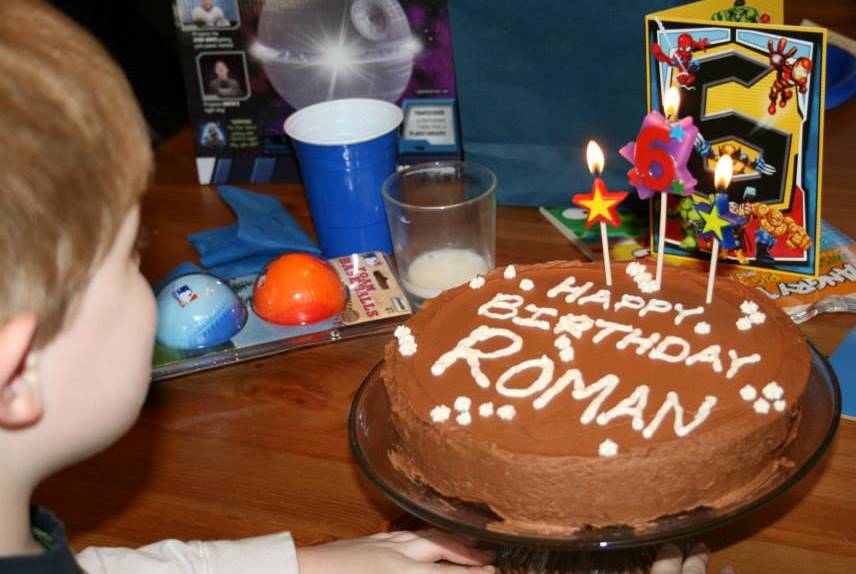
Roman's Birthday Cake 2Our nephew Roman turned six yesterday. Mike and I moved back to Pittsburgh right after he was born, so we’ve had front-row seats to watch him grow up. It seems like just last week he was swaddled and drinking from a bottle. Now, he plays Angry Birds on my brother’s iPad and runs around the house with a light sabre telling me that “Jedi knights only need to sleep once a year, Auntie,” when I attempt to put him to bed.

Roman is a funny, intelligent lad who requested a chocolate cake with chocolate icing for his birthday. It’s an easy recipe, yielding a single layer cake that is good for smaller parties (we hosted Roman’s family party, with seven people in attendance, at it worked out very well). To complement our outer space theme, I also baked Planet Cupcakes with Vanilla Buttercream Frosting and used some of the vanilla buttercream to decorate this cake.

For the Chocolate Cake (originally posted on 12/29/12)

Ingredients

  • 1 cup flour
  • 1 cup sugar
  • 1/4 cup unsweetened cocoa powder
  • 1 teaspoon baking powder
  • 1/4 teaspoon salt
  • 3/4 cup milk
  • 1/4 cup shortening
  • 1/2 teaspoon vanilla
  • 1 egg

Preparation

Preheat oven to 350 degrees.

Prepare the pan one of two ways: grease the bottom, line it with a circle of waxed paper, then grease the paper and the sides of the pan and flour well, or use Wilton Bake Easy! Nonstick spray. This time, I used the Wilton spray and it worked very well.

In a mixing bowl, combine flour, sugar, baking powder, and salt.

Add milk, shortening, and vanilla, beating on medium speed for two minutes.

Add egg and beat on medium speed for another two minutes.

Pour batter into prepared pan; it will be a light brown color and very fluffy in texture.

Bake for 30 minutes, or until a cake tester inserted in the center comes out clean.

Cool cake on a wire rack in the pan for 10 minutes, then remove from the pan (if you desire) to cool completely.

For the Chocolate Almond Buttercream Frosting

Ingredients

  • 8 tablespoons butter, softened to a texture like ice cream (not too soft)
  • 1 1/2 cups powdered sugar, sifted
  • 1/4 cup cocoa powder, sifted
  • 1/8 teaspoon salt
  • 1 tablespoon vanilla extract
  • 1 tablespoon almond extract
  • 1 tablespoon milk

Preparation

In a mixing bowl, beat butter for about 30 seconds.

Scrape down the sides of the bowl and add powdered sugar and cocoa powder. Cover your mixer with a kitchen towel to prevent a powdered sugar/cocoa storm and set your mixer on low, beating until all the sugar and powder is incorporated into the butter; this takes a few minutes.

Add vanilla and beat for one to two minutes, then add the almond and beat for a few minutes, and finally the milk, beating for a few minutes. You want a very smooth, easily-spreadable texture.

Frost the cake according to your preferred frosting thickness; decorate as you like.


Chocolate Cake

chocolate cake


My five-year-old nephew Roman took a bite of a homemade sugar cookie on Christmas Day and made a face I wasn’t expecting: he wrinkled his nose and shook his head, the universal sign for “I don’t like this.” How could this be, I wondered? He’s a kid, right? Don’t children love sugar?

My brother Andy, Roman’s dad, remarked that kids eat a lot of processed foods, that they’re not necessarily used to homemade tastes. This make me think about the difference between the baked goods you buy at the store–packaged cookies, boxed cake mixes–and how different they really are from homemade. If you bake a cake from a mix, you’ll get fluffy, moist layers that will stay fresh for several days. Bake a cake from eggs, flour, butter, and sugar, and you’ll get a denser, more crumbly treat that lasts three, maybe four days tops (depending on your ability to resist slicing up a huge piece every time you pass your cake stand).

This recipe is a simple, one-bowl affair that requires no melted chocolate, just cocoa powder, and yields a single layer. Caramel frosting pairs well with this cake, but I chose to dust it with powdered sugar, make some whipped cream, and serve it “plain.”

Ingredients

  • 1 cup flour
  • 1 cup sugar
  • 1/4 cup unsweetened cocoa powder
  • 1 teaspoon baking powder
  • 1/4 teaspoon salt
  • 3/4 cup milk
  • 1/4 cup shortening
  • 1/2 teaspoon vanilla
  • 1 egg
  • Powdered sugar, for dusting
  • Sweetened whipped cream, for garnish, if desired

Preparation

Grease and flour a nine-inch round cake pan; set aside. Note: if you plan to leave the cake in the pan, you can simply grease and flour it, but if you wish to remove the cake from the pan to set it on a cake stand, I recommend greasing the bottom of the pan, lining it with a circle of waxed paper, then greasing and flouring the paper.

In a mixing bowl, combine flour, sugar, baking powder, and salt.

Add milk, shortening, and vanilla, beating on medium speed for two minutes.

Add egg and beat on medium speed for another two minutes.

Pour batter into prepared pan; it will be a light brown color and very fluffy in texture.

Bake for 30 minutes, or until a cake tester inserted in the center comes out clean.

Cool cake on a wire rack in the pan for 10 minutes, then remove from the pan (if you desire) to cool completely.

Dust with powdered sugar and top with sweetened whipped cream if desired.

Sweetened Whipped Cream

Ingredients

  • 3/4 cup whipping cream
  • 3-4 tablespoons powdered sugar

Preparation

Chill your bowl and beaters (or whisk attachment) for 10-15 minutes.

Add whipped cream and powdered sugar to the chilled bowl and beat on medium, then medium-high speed until soft peaks form.


Buche de Noel

yule log


At last…buche de noel. This cake took me literally all day to make, between other baking, errands, and visits. A quick internet search revealed the the yule log was a literal log, tossed on the fire around winter solstice. The literal log somehow evolved into a French treat of chocolate cake, whipped cream-like filling, and chocolate ganache frosting. I love traditional buche de noel, but since my mom is coming over for Christmas dinner tomorrow and she doesn’t eat chocolate, voila…almond buche de noel!

Part One: Almond Sponge Cake

Ingredients

  • 4 eggs
  • 3/4 cup sugar
  • 1 teaspoon almond extract
  • 3/4 cup flour
  • 1 teaspoon baking powder
  • 1/2 teaspoon salt

Preparation

Grease a 10 x 15 x 1 baking pan; line with parchment and grease the parchment; set aside.

In a small bowl, combine flour, baking powder, and salt; set aside.

In a mixing bowl using the whisk attachment, beat eggs on medium speed for three minutes.

Gradually add sugar and beat until mixture is thick and lemon-colored.

Stir in almond extract.

Gently fold in flour mixture.

Pour batter into prepared pan.

Bake 15 minutes, until center of cake springs back when touched.

Remove from oven; flip onto a cooling rack, remove parchment paper, then quickly flip onto a towel coated with powdered sugar.

Roll up tightly from the short end, place on a cooling rack, and allow to cool completely before filling.

Part Two: Almond Whipped Cream Filling

Ingredients

  • 3/4 cup whipping cream
  • ½ teaspoon almond extract
  • 3 tablespoons powdered sugar

Preparation

In a chilled bowl, combine whipping cream, almond extract, and powdered sugar.

Using a chilled whisk beater, beat on medium speed until soft peaks form.

Carefully un-roll cake and spread filling inside.

Re-roll cake tightly in plastic wrap and place in the refrigerator for a few hours before frosting.

Part Three: Vanilla Buttercream Frosting

Ingredients

  • 8 tablespoons butter, room temperature
  • 1 1/2 cups powdered sugar, sifted
  • 1/8 teaspoon salt
  • 1 tablespoon vanilla extract

Preparation

Place butter in a mixing bowl fitted with a paddle attachment and beat for a few minutes.

Add powdered sugar, and with the mixer on low, beat until all sugar is incorporated into the butter. (Hint: I place a kitchen towel over my mixer during this stage to prevent a powdered sugar blizzard.)

Increase speed to medium; add vanilla and beat for three minutes, then taste. If you’d like a stronger vanilla flavor or to increase the sweetness, add additional extract and a few tablespoons of powdered sugar.

Remove cake from plastic wrap; cut off each end to create a flat surface, or leave intact for a more rustic appearance. Brush off excess powdered sugar, otherwise your frosting will not stick.

Frost cake to look like a log, using broad strokes with a butter knife.

Pumpkin Roll


I love that scene in “Julie & Julia” when Julie Powell kneels before her coffee table, preparing to follow along with the episode of “The French Chef” in which Julia Child de-bones a duck. With that scary chef’s knife in her hand, Julie nods to the television and says, as if hoping to convince herself, “No fear, Julia.”

I thought about this scene while contemplating pumpkin roll over the past few weeks. The concept of the pumpkin roll has long intimidated me. Roll the piping hot cake in a tea towel? What if it cracks? What if it sticks to the towel? What if it’s a total disaster?

Well, if Julie Powell could de-bone a duck, then surely I could make a pumpkin roll.

I summoned as much bravery as possible, mixed my ingredients, and baked my cake. There was a precarious, breath-holding moment when I flipped the cake out of the pan onto a cooling rack, peeled back the waxed paper, then immediately slid it onto the sugar-coated towel. With hope, I rolled the cake in the towel and set it on a cooling rack.

A few hours later, with the filling prepared, I stood before my towel-wrapped cake. Carefully peeling back the towel, I discovered that it was not only intact, but crack-free. After slathering on the filling I re-rolled the cake, secured it in plastic wrap, and with a profound sense of satisfaction, placed it in the fridge to chill.

No fear, bakers.

Ingredients

For the cake:

  • 3/4 cup flour
  • 1/2 teaspoon baking powder
  • 1/2 teaspoon baking soda
  • 1/2 teaspoon cinnamon
  • 1/2 teaspoon cloves
  • 1/4 teaspoon salt
  • 3 eggs
  • 1 cup sugar
  • 2/3 cup pumpkin

For the filling:

  • 8 ounces cream cheese, room temperature
  • 6 tablespoons butter, room temperature
  • 1 cup powdered sugar, sifted
  • 1 teaspoon vanilla extract

Preparation

For the cake:

Preheat oven to 375 degrees.

Grease a 10 x 15 jelly roll pan, then line with waxed paper and grease and flour the paper.

Place a clean tea towel (linen or flour sack, nothing too textured) on the counter top and sprinkle it generously with powdered sugar.

In a small bowl, combine flour, baking powder, baking soda, cinnamon, cloves, and salt; set aside.

In a mixing bowl, combine eggs and sugar. Beat until thickened, about three to five minutes.

Add pumpkin and beat well.

Stir in flour mixture.

Pour batter into prepared pan and smooth out the top.

Bake for 13 minutes; the top should be just golden-brown and spring back slightly when pressed.

Working quickly and carefully, invert the pan onto a cooling rack, peel off the waxed paper, and slide or flip the cake onto the tea towel.

Roll up the cake and allow to cool on a wire rack completely before filling.

For the filling:

In a mixing bowl, combine cream cheese and butter; beat until smooth.

Add powdered sugar and vanilla and beat until very well combined.

Carefully un-roll the cake from the tea towel.

Spread filling in an even layer, leaving about a half-inch border at the long edges.

Re-roll the cake and wrap in plastic wrap; refrigerate at least one hour before serving.

Buttermilk Chocolate Sheet Cake


Long before fondant dominated the Food Network and entire shows were dedicated to bakeries who could fashion cakes into realistic reproductions of Hogwarts Castle, there was the sheet cake.  The sheet cake is, for those who prefer not to spend more on a cake than they’d spend on a car payment, the go-to dessert for family or professional gatherings, celebrating birthdays, baby showers, graduations, and office farewells.

As far as I can tell, the world is divided into two groups of people: those who want the corner piece, and those who do not (much like those who want raisins in their oatmeal cookies, and those who do not).  We corner-piece folks cannot imagine why others prefer the cake to the frosting, for it is precisely the ample portion of frosting—on all three sides—that draws us to the corner piece in the first place.

This recipe is also known as a Texas Sheet Cake and employs an interesting technique of cooking cocoa powder and butter for both the batter and the frosting, and by pouring the frosting over the cake while it is still warm.  The recipe can be baked in a 15x10x1 jelly roll pan for 25 minutes, but as I don’t have one of those (yet) I employed my 13x9x2 and it worked just fine.

Buttermilk Chocolate Cake

Ingredients

  • 2 cups flour
  • 2 cups sugar
  • 1 teaspoon baking soda
  • 1/4 teaspoon salt
  • 1 cup butter
  • 1/3 cup unsweetened cocoa powder
  • 1 cup water
  • 2 eggs
  • 1/2 cup buttermilk
  • 1 1/2 teaspoons vanilla extract

Preparation

Grease and flour a 13x9x2 sheet cake pan; set aside.

Preheat oven to 350 degrees.

In a mixing bowl, combine flour, sugar, baking soda, and salt.

In a medium saucepan, combine butter, cocoa powder, and water.  Cook, stirring constantly, until the mixture just comes to a boil.

Remove from heat and combine with dry ingredients, beating on medium speed until well-combined.

Add eggs, buttermilk, and vanilla and beat on medium speed for one minute.  Batter will be very thin.

Pour into prepared pan and bake for 35 minutes or until a cake tester comes out clean.

Just after the cake has come out of the oven, prepare the frosting so that it can be spread on the cake while the cake is still warm.

Buttermilk Chocolate Frosting

Ingredients

  • 4 tablespoons butter
  • 3 tablespoons unsweetened cocoa powder
  • 3 tablespoons buttermilk
  • 2 1/4 cups powdered sugar, sifted
  • 1 teaspoon vanilla extract

Preparation

In a medium saucepan, combine butter, cocoa powder, and buttermilk.

Cook on medium heat, stirring constantly, until mixture comes to a boil.

Remove from heat and vigorously stir in powdered sugar and vanilla until smooth.

Pour over warm cake and spread with a spatula.

Cinnamon Coffee Cake


In one of my favorite movies, Sense & Sensibility, Margaret Dashwood asks Colonel Brandon what it’s like in the East Indies.  He replies, as if imparting a great secret, “The air is full of spices.”

Whenever someone asks what that wonderful flavor is in a dish, it’s usually a spice.  Spices can be subtle, enhancing the flavors of other ingredients—the way pepper does, for example.  They can also be the main component, around which other ingredients are based, like in a cinnamon roll.

Cinnamon is a delightful aromatic spice that has been cultivated around the world for centuries.  I use Vietnamese cinnamon, which has a more complex flavor than your average grocery store-bought variety, but you can certainly bake with any kind.

From the moment this cake went into the oven, my kitchen was filled with the aromatic scent of cinnamon, and it lingered for hours after the cake was done.  The honey glaze is a surprising addition, offering a smooth, sweet flavor that complements the warm, spicy cinnamon cake.

For the streusel:

  • 1/4 cup packed brown sugar
  • 1/2 cup flour
  • 1 1/2 teaspoons cinnamon
  • 1/4 teaspoon salt
  • 3 tablespoons cold butter, cut into cubes

In a medium bowl, combine brown sugar, flour, cinnamon, and salt.

Cut in butter with a pastry blender (or two knives) until the mixture resembles small peas.

Place in the freezer until cake batter is ready.

For the cake:

  • 2 1/2 cups cake flour
  • 2 teaspoons baking powder
  • 1/2 teaspoon baking soda
  • 1/4 teaspoon cinnamon
  • 1/4 teaspoon nutmeg
  • 1/2 teaspoon salt
  • 12 tablespoons butter, room temperature
  • 1 1/2 cups sugar
  • 3 eggs, room temperature
  • 1 1/2 teaspoons vanilla extract
  • 1 1/4 cup sour cream

Spray a 10-inch tube pan with vegetable spray and line the bottom with parchment paper.

In a medium bowl, sift together flour, baking powder, baking soda, cinnamon, nutmeg, and salt; set aside.

Cream together butter and sugar until very light and fluffy.

Add eggs, one at a time, beating well after each.

Add vanilla and sour cream, beating until just combined.

With the mixer on low, add flour mixture in thirds until just combined, scraping the sides of the bowl as necessary.

Remove streusel mix from the freezer.

Spoon half the batter into the tube pan and spread evenly with a spatula; sprinkle 3/4 of the streusel mix over the top.

Spoon the remaining batter into the pan, spreading evenly with a spatula; sprinkle the remaining streusel mix on the top.

Bake for 50 minutes, until a cake tester comes out clean.

Place the pan on a wire rack to cool before drizzling with glaze.

For the honey glaze:

  • 2 cups powdered sugar
  • 3 tablespoons honey
  • 2 tablespoons water

In a small bowl, mix the powdered sugar, honey, and water together and stir until smooth.

If the glaze is too thick, add a small amount of water to thin it slightly; if the glaze is too thin, add a small amount of powdered sugar to thicken it.

Drizzle over cake.

Devil’s Food Cake


Mike’s first “real” job as a newspaper reporter took us to LaPlata, Maryland.  After we moved there it took me a few months to find a job, so I spent the summer baking, sending the results of my confectionery endeavors in to his office.  This cake was a particular favorite, proclaimed by one of his colleagues to be worthy of a blue ribbon at the county fair.  Allegheny County doesn’t have a fair, but if it did, you can bet I’d enter this in it.

I’ve found that if you grease cake pans, then line them with waxed paper or parchment paper and grease the paper before flouring the pan, your cakes will pop out easily.  You can certainly use the traditional grease and flour method without the paper, but this is my preferred technique.  To make the liners, I place the paper down on a counter top, lightly trace its circumference with the tip of a knife, then cut a slightly smaller circle of paper to fit inside the pan.

Also, when I frost cakes, I always frost the sides last.  You can certainly frost the top last if you’d prefer, but I find that saving the sides for last makes a smoother edge where the side meets the top.  I’m not a huge fan of elaborate decorations on cakes, so I use an offset spatula and smooth strokes to create a very homemade, old-fashioned appearance. 

Ingredients


  • 2 1/4 cups flour
  • 1/2 cup unsweetened cocoa powder
  • 1 1/2 teaspoons baking soda
  • 1/4 teaspoon salt
  • 1/2 cup shortening
  • 1 3/4 cups sugar
  • 1 teaspoon vanilla
  • 3 eggs
  • 1 1/3 cups water
  • 1 recipe fudge frosting

Preparation

Preheat oven to 350 degrees.

Lightly grease two 9-inch round cake pans.  Line the bottom of each with waxed paper, lightly grease the waxed paper, and lightly flour each pan.

In a medium bowl, combine flour, cocoa powder, baking soda, and salt.  Mix well and set aside.

In a mixing bowl, beat shortening on medium speed for 30 seconds.

Add sugar and vanilla; beat until combined.

Add eggs, one at a time, beating until combined after each.

Add flour mixture and water alternatively in three batches, beating on medium speed until just combined.

Divide batter evenly between the pans and bake for 35 minutes, or until a cake tester inserted in the center comes out clean.

Cool in pans for about 10 minutes; run a knife around the edge of each pan to loosen the cakes, then turn them out onto cooling racks and remove the waxed paper from the bottom.  Flip right-sides up and allow to cool completely before frosting.