Coconut Cream Pie

Few foods are as polarizing as coconut. People love it, people hate it. Toasted is fine, raw is not. The question of do you like Samoas during Girl Scout Cookie season can start riots. Well, maybe not riots. But people have very strong opinions about these things.

I love coconut, but only under certain circumstances: if it’s toasted and sprinkled onto something, or baked into a treat like in seven-layer bars or Samoas, or just coconut flavored…these are all acceptable things to me. I definitely sampled the custard portion of this coconut cream pie before I stirred in the raw coconut, and it tasted absolutely delicious. Maybe someday I’ll make this without the raw coconut in the filling and see what happens – for now, credit for this recipe goes mostly to Sally’s Baking, one of my favorite recipe sources – but I consulted several different sites for ingredient lists and preparation processes before going with the one below.

Ingredients

For the crust

  • 1 1/4 cups flour
  • 1/2 teaspoon salt
  • 3 tablespoons butter, chilled and cut into cubes
  • 1/3 cup vegetable shortening, chilled and cut into cubes
  • 1/4 cup ice cold water

For the filling

  • 4 egg yolks
  • 1/4 cup cornstarch
  • 14-ounce can full-fat coconut milk (find this in the Asian or Latin American aisle at the grocery store)
  • 1 cup half-and-half
  • 2/3 cup sugar
  • 1/4 teaspoon salt
  • 1 cup sweetened shredded coconut
  • 2 tablespoons butter, softened
  • 1 teaspoon vanilla extract
  • 1/2 teaspoon coconut extract (optional)

For the topping and garnish

  • 1 1/2 cups heavy cream
  • 3 tablespoons powdered sugar
  • 3/4 teaspoon vanilla extract
  • About 4 tablespoons sweetened shredded coconut, toasted*

Preparation

Make your crust: You can do this a day before, as it needs plenty of time to chill. In a large bowl, whisk flour and salt together. Using a pastry cutter, cut in butter and shortening until the mixture looks like coarse crumbs – this means pea-sized pieces, but it doesn’t have to be totally uniform.

Measure out 1/4 cup of water and add ice; stir, then pour out 1/4 cup to use in your dough. Drizzle into flour mixture 1 tablespoon at a time, stirring with a spatula after each addition. Stop adding water when the dough starts to form large clumps. Transfer to a floured work surface and flour your hands, then fold the dough into itself to fully incorporate the butter and shortening into the dry mixture. Be gentle – pastry doesn’t like to be handled too much or it gets tough. Flatten into a disc, cover in plastic wrap, and chill for at least 2 hours.

Once your dough is chilled, it’s time to blind bake the crust. Lightly flour your work surface and roll out your pie dough to a circle about 12 inches wide; this will fit into a 9-inch pie dish. Gently transfer to the pie dish and flute or crimp your edges; chill for 30 minutes.

While your dough is chilling, preheat your oven to 375 degrees. Line the chilled crust with parchment paper and fill with pie weights or dried beans (I’ve been blind-baking crusts with dried beans forever). Bake for 15-16 minutes, until edges are set and starting to brown. Remove the weights/beans and parchment and continue baking for another 14-15 minutes, until bottom is golden brown. My crust shrank a bit during this phase, but it was still perfectly fine. Remove from oven and allow to cool completely before making the filling.

Make your filling: In a large glass measuring cup (like the 4-cup variety), whisk egg yolks and cornstarch; set aside. In a medium saucepan, combine coconut milk, half-and-half, sugar, and salt. Cook over medium heat, whisking regularly, and bring to a boil. Boil for 2 minutes, then reduce the temperature to medium-low heat.

Remove about 1/2 cup of the mixture and, pouring a slow, steady stream, whisk into the egg yolk/cornstarch mixture to temper the eggs – keep your whisk moving so they don’t scramble. Pour this mixture back into the pot (again, slowly and steadily), whisking constantly to combine. The mixture will thicken immediately; keep whisking and cooking for another 90 seconds. Remove from heat and stir in coconut, butter, vanilla extract, and coconut extract; pour into cooled pie crust. Cover the surface of the filling with plastic wrap and refrigerate until set, at least 3 hours or overnight.

*Now is a great time to toast your coconut for the garnish! Place about 4 tablespoons of sweetened shredded coconut into a shallow frying pan over medium-low heat. Stir consistently, keeping a very close eye, until the coconut turns golden brown. Keep your coconut moving so it doesn’t burn! You can also do this in a 350-degree oven, stirring every few minutes. Remove from pan and allow to cool completely.

Once the pie is set, make your whipped cream and garnish. Place heavy cream, powdered sugar, and vanilla extract into the bowl of a stand mixer fitted with the whisk attachment. Whisk on low, then medium speed, until medium peaks for – this takes about 3-4 minutes. Transfer whipped cream to a piping bag fitted with a large star tip.

Remove pie from the fridge and remove the plastic wrap; pipe stars all over the pie surface to fully cover it, then sprinkle with toasted coconut. Keep the pie in the refrigerator until you’re ready to serve it; makes about 8 servings.
Kentucky Derby Pie

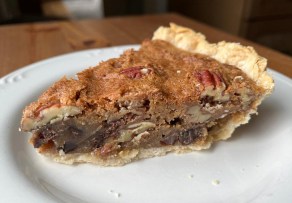
derbypieThe Kentucky Derby is in May…so why I did bake a derby pie in November? Well, Mike made shrimp and grits on Friday, and I wanted a dessert to complement it. But the recipe I tried failed, and once I fail at a recipe I must try again. I’ve spent literal years perfecting honey cake and buttercream, my friends. I could not let something that sounded as delicious as derby pie – essentially a pecan pie with chocolate and bourbon – go unperfected.

And so I took to the internet, searching for a recipe that seemed more feasible than the one I’d tried to make. I found this recipe at The Happier Homemaker, and it turned out great. I think I overbaked mine a bit, so next time I’ll pull it a few minutes earlier. And while I should probably call this Migraine Pie – because as it contains both chocolate and alcohol, I’m putting myself at migraine risk by eating it – it is absolutely delicious, almost like a chocolate chip blondie in pie crust, but not exactly. You’ll just have to make it and see what I mean.

Ingredients

For the pie crust

  • 1 1/4 cups flour
  • Dash of salt
  • 1/3 cup shortening
  • 4-5 tablespoons ice water

For the filling

  • 1 stick butter, melted
  • 1/2 cup dark brown sugar
  • 1/2 cup white sugar
  • 2 eggs
  • 1 teaspoon vanilla extract
  • 2 tablespoons Kentucky bourbon
  • 1/2 cup flour
  • 1/2 teaspoon salt
  • 1 cup pecan halves
  • 1 cup semisweet chocolate chips

Preparation

Preheat oven to 350 degrees. Place a pie dish on a baking sheet to catch any drips if your filling bubbles over the edges.

Make the crust: in a large bowl, combine flour, salt, and shortening. Cut the shortening in with a pastry cutter until the mixture looks like coarse crumbs. Drizzle two tablespoons water over the mixture and toss with a fork to combine; add enough water to bring your dough together, but be careful not to make the dough too wet. Gather dough into a ball and roll out to about a 12-inch circle; carefully lift into your pie pan, and trim and crimp the edges.

Make the filling: In a large bowl, combine melted butter and sugars, whisking to combine. Whisk in eggs, vanilla, and bourbon, then fold in flour and salt. Stir in pecans and chocolate chips.

Pour filling into the pie shell and bake for about 55-60 minutes. Remove from oven and allow to cool just slightly before serving, or chill and serve cold. Store in an airtight container in the refrigerator for 2-3 days; makes about 8 servings, depending on how generously you slice it. 


Apple Hand Pies

Mike requested apple hand pies for this weekend’s treat. I need to continue developing my pastry skills, and this was excellent practice. Because I chose to focus on the pastry, I decided to use canned apple pie filling, but you could absolutely use fresh apple filling if you prefer. Next time, I probably will.

The crust recipe comes from Live Well Bake Often, and it’s probably my favorite I’ve come across so far. I also used some crust-making techniques I learned from this incredibly comprehensive video from King Arthur Flour, and feel like this pastry-making experience was the easiest that I’ve ever had. While the pies look like tiny flying saucers, Mike says they’re absolutely delicious.

Ingredients

  • 2 1/2 cups (315 grams) flour – use the spoon and level method if you’re measuring by volume
  • 2 teaspoons sugar
  • 1 teaspoon salt
  • 8 tablespoons unsalted butter, cold, cut into cubes
  • 8 tablespoons vegetable shortening, cold, cut into cubes
  • 1/2 cup ice water
  • 1/2 of a 21-ounce can apple pie filling
  • Nutmeg
  • Cinnamon
  • 1 egg
  • 1 tablespoon milk
  • Sanding sugar

Preparation 

In a large bowl, stir together flour, sugar, and salt. Add butter and shortening, tossing with a fork to coat. Use a pastry blender to combine the butter and shortening into the flour mix until the mixture looks like coarse crumbs. Drizzle in water1 tablespoon at a time and mix with a fork until the dough begins to combine; you may not need the full half-cup, but I did.

Turn the dough out onto a sheet of parchment paper and use the paper to gather the dough into a rough rectangle shape; fold the dough over on itself a few times to fully incorporate the wet and dry ingredients. The technique in the video around 7:03 is really helpful here. Shape the dough into a rectangle and chill for 1 hour.

Preheat oven to 400 degrees. Line two baking sheets with parchment paper.

Scoop out half the can of pie filling into a medium bowl and chop up the apples into chunks. Add nutmeg and cinnamon to taste; set filling aside while you roll and shape your crust. Reserve the remaining filling for another use; you can heat it up and serve it over ice cream, or just warm it and eat it by itself as a side dish.

Remove crust from fridge and place on a lightly floured surface, rolling into a rectangle about 1/8 inch thickness. Using a 3 1/2 inch cookie cutter, cut out circles of crust; re-roll scraps and repeat. Place half of the circles on the baking sheet and top with about a tablespoon of filling. Punch a steam hole in the remaining circles using a small cutter (I used a frosting piping tip) or knife and place the top crusts over the filling, pinching the edges to join the bottom and top crusts. Gently press the edges with a fork to seal.

In a small bowl, beat together the egg and milk to make an egg wash and brush over the pies, then sprinkle with sanding sugar. Bake for 20-22 minutes, until the pies are golden brown. Remove from oven and cool for a few minutes on the baking sheet, then remove to a wire rack to cool completely. Store in an airtight container at room temperature for 2-3 days. Makes 10 pies (my recipe made nine round pies, plus one larger half-circle shaped pie that I made from the last of the scraps).

Butterscotch Pie II

Some time ago, I made butterscotch pie, and my filling didn’t set well. I suspect that I didn’t cook it long enough, but then again, I was pretty much a pie-baking amateur at the time. I’m pleased to report that this recipe from Trisha Yearwood at Food Network delivered a wonderful, fully set filling.

While Trisha’s recipe calls for a meringue, I decided to leave the meringue out; you can use your three leftover egg whites to make meringue cookies or almond clouds (adapting the recipe to account for the extra whites in each of those recipes), or make a meringue for your pie if you like. Personally, I’m more of a whipped cream/whipped topping-on-pie kind of gal, but whatever floats your boat. I also have to admit that I used a store-bought pie crust for this, but as I’ve mentioned in previous pie posts, sometimes you just want to focus on your filling, and such was the case with this pie.

Ingredients

  • 1 9-inch pie crust, store-bought or homemade
  • 1 cup packed light brown sugar
  • 4 tablespoons heavy cream
  • 3 tablespoons unsalted butter
  • 2 cups milk
  • 3 tablespoons corn starch
  • 3 egg yolks
  • 1/2 teaspoon vanilla extract

Preparation

Pre-bake pie crust and allow to cool completely before filling.

In a medium saucepan, combine brown sugar, heavy cream, and butter. Cook over medium heat until the sugar dissolves and the mixture boils; continue to boil for 5 minutes, stirring frequently, until the mixture thickens and turns darker in color. Remove from heat; reserve 1 tablespoon milk and slowly pour remaining milk into the sugar mixture.

In a small bowl, combine the reserved 1 tablespoon milk, cornstarch, egg yolks, and vanilla extract; whisk together until smooth. Return the sugar/milk mixture to medium heat and add the cornstarch mixture, stirring well to combine. Continue to cook over medium heat, stirring constantly, until the mixture thickens; Trisha’s recipe says this takes 3 minutes, but my filling took at least 10 minutes to get thick. Large bubbles will appear in the pan when your filling is ready.

Pour filling into baked pie shell and immediately place a piece of plastic wrap directly on the top of the filling. Refrigerate until the filling is set, about 4 hours or overnight.

Remove plastic wrap and top with whipped cream or whipped topping before serving.

Store in the refrigerator.


Pumpkin Molasses Pie

pumpkin-molasses-pieWhat makes pumpkin pie better? Molasses. But what is molasses, exactly?

Molasses is a syrup that results from sugar production. To make sugar, sugar cane or beets are crushed to extract their juice, which is then boiled down to form sugar crystals. The crystals are taken out, and the remaining juice is molasses, which may be boiled two or three more times to extract more crystals. The most common type of molasses used in baking comes from the first boiling; it is the lightest in color and sweetest in taste. The second boiling results in dark molasses, and the third results in blackstrap molasses, which is the thickest and most bitter-tasting. Blackstrap molasses is said to have health benefits because it contains vitamin B6 and minerals like calcium and magnesium, but it’s usually not recommended for baking. In fact, I’ve read many a recipe that calls for molasses and then indicates “not blackstrap” to ensure a sweet result.

Last week, I took some pumpkin molasses cookies to work and my colleague Linda told me that she had a good recipe for pumpkin molasses pie. Naturally, I had to try it…and it was just as delicious as I expected.

Ingredients

  • 1 single pie crust, unbaked
  • 1 1/2 cups canned pumpkin puree
  • 1 cup firmly packed light brown sugar
  • 1/2 teaspoon salt
  • 2 teaspoons cinnamon
  • 1 teaspoon ginger
  • 2 tablespoons molasses
  • 3 eggs, lightly beaten
  • 1 cup evaporated milk

Preparation

Preheat oven to 425 degrees. Line an 8-inch pie dish with crust, then trim and shape edge as you like. I did a classic crimped edge for this crust.

Place your pie dish on a rimmed baking sheet lined with parchment paper to catch any spills.

In a large mixing bowl, stir together pumpkin puree, light brown sugar, salt, cinnamon, ginger, and molasses. Add eggs and evaporated milk, stirring very well to combine.

Pour filling into pie dish and place a crust shield* around the edge to prevent over-browning. Bake for 30 minutes, then remove the crust shield and continue baking another 10-15 minutes. Pie is done when a toothpick inserted in the center comes out clean; don’t worry about the little hole it will leave, as you can always cover this up with whipped cream before serving.

Remove pie from oven and cool completely before serving. Pie will be very puffy when it first comes out of the oven and will fall as it cools – this is completely fine.

Store pie in the refrigerator for up to 3-4 days.

*You can buy a crust shield at King Arthur Flour and many baking supply stores. If you don’t have one handy, take a 12-inch piece of foil and fold it into quarters. Take scissors and cut out the center, leaving a 2-inch wide ring. Carefully unfold the foil and place the guard on your pie edge. 

Peach Pie with Lattice Crust

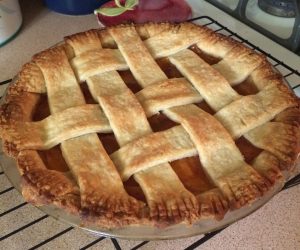
peach pieSometimes I use canned pie filling. There, I admit it.

When you want to practice your latticework, it’s just a lot easier to make your crust from scratch, pop open a can of filling, and focus on your lattice strips than it is to worry about peeling your fruit and such. Someday, I’m sure I’ll make a peach pie from scratch, but in the meantime, my can of Lucky Leaf pie filling worked very well.

This is my third lattice-topped pie, and I think it’s the best appearance-wise. I had two crusts left over from yesterday’s lemon meringue pie adventure, and I still have a bit of crust left over from making my lattice, which I might turn into pie crust rolls later.

Ingredients

  • 2 pie crusts
  • 1 can peach pie filling
  • 1/4 teaspoon cinnamon

Preparation

Preheat oven to 425 degrees.

Mix cinnamon and pie filling; set aside.

Prepare pie crusts; line an 8-inch pie plate with one crust and reserve the second crust for the lattice top.

Roll out your second crust, then cut into 1 1/2 inch strips for the lattice. You’ll need 7 strips for this design.

Pour filling into pie dish; place four lattice strips on top. Fold back the first and third strips, then place another strip on your filling so it is perpendicular to the other strips. Fold back the strips so they cover the new strip, then repeat with remaining strips to form the lattice. If you’d like some video help, check out this tutorial from the folks at Southern Living magazine.

Fold the edges of your lattice strips over the edge of your bottom crust to seal. Gently press the tines of a fork into the crust vertically, then horizontally, all the way around your crust to create a crisscross design.

Place a pie guard or foil around the edge of your crust and bake for 25 minutes; remove pie guard and continue baking for 10 minutes.

Cool on a wire rack before serving.

Lemon Meringue Pie

lemon meringue pie

Lemon meringue pie reminds me of my grandpap, Andy Kozusko, Sr. It was his favorite, and a few times a year my grandma Zella made one for him, completely from scratch, of course.

My grandpap was a member of the Greatest Generation, born in Pittsburgh to Slovak immigrants in August 1921. He served in the Navy during World War II; he worked hard, knew how to fix everything, took great pride in his home and lawn, drove me to school, volunteered as a fireman, and served as a usher at church. He had more patience and gratitude than any person I’ve ever known.

This recipe comes from the Better Homes & Gardens Cookbook, and although the filling is kind of runny, it tastes delicious. I suspect that if my grandpap were here today, he’d thank me for making him a pie, tell me it was delicious, and ask for a second piece…because he was just that kind of man.

Ingredients

For the crust

For the filling

  • 3 egg yolks, beaten
  • 1 1/2 cups sugar
  • 3 tablespoons flour
  • 3 tablespoons cornstarch
  • dash of salt
  • 1 1/2 cups water
  • 2 tablespoons unsalted butter
  • zest of 1 medium lemon
  • 1/3 cup lemon juice

For the meringue

  • 3 egg whites, at room temperature
  • 1/2 teaspoon vanilla
  • 1/4 teaspoon cream of tartar
  • 6 tablespoons sugar

*My pie crust recipe yields 3 crusts, enough for this pie and either one or two more, depending on what you choose to make. Check out my pie ideas!

Preparation

Preheat oven to 350 degrees. Place beaten egg yolks in a large glass measuring cup next to your stove.

In a medium saucepan, combine sugar, flour, cornstarch, and salt; mix well. Slowly pour in water, stirring constantly to break up lumps. Cook and stir over medium-high heat until thickened and bubbly; once you see large bubbles break on the surface, it’s ready. Turn heat down to medium-low and continue cooking and stirring for 2 minutes more.

Gradually stir about 1 cup of hot filling into egg yolks, whisking constantly to temper. Pour the yolk/filling mixture back into the pan and bring to a gentle boil, then cook and stir for 2 minutes more.

Remove from heat and stir in lemon zest and butter, stirring until butter completely melts. Very carefully stir in lemon juice; keep filling warm while you make the meringue.

In a mixer fitted with the whisk attachment, whisk egg whites, vanilla, and cream of tartar on medium speed until soft peaks form (soft peaks will curl).  Gradually add sugar, 1 tablespoon at a time, and beat on high speed until stiff peaks form and meringue is glossy; this will take about 4 minutes.

Pour filling into pre-baked pie crust and gently top with meringue, spreading over filling and sealing to the edge of the crust to prevent it from shrinking.

Bake for 15 minutes; remove to a wire rack to cool for 1 hour, then cover and refrigerate for 3-6 hours before serving. Store in the refrigerator.


Apple Crumb Pie

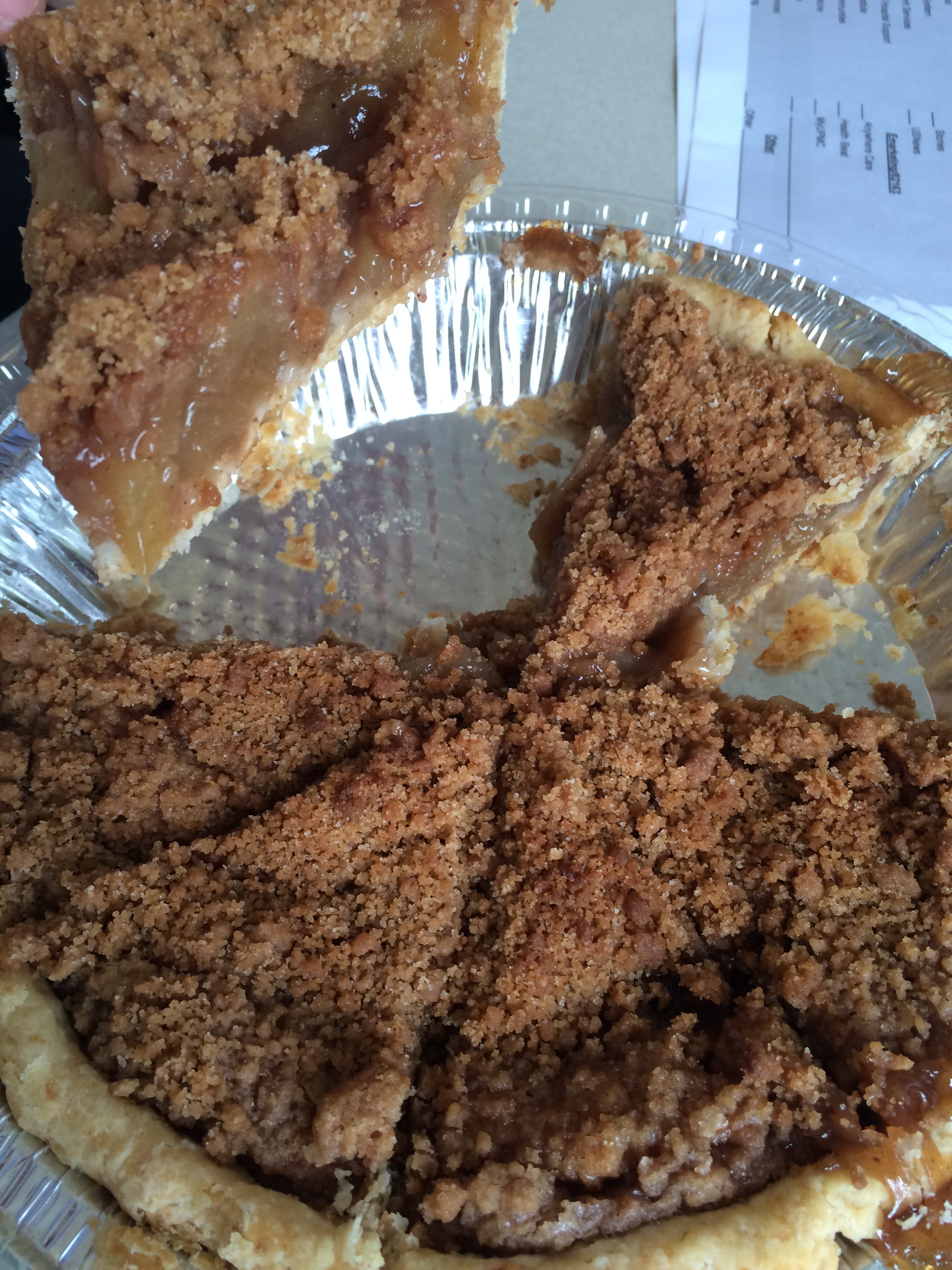
applecrumbpie1Confession: as much as I love to bake apple pie, I don’t eat it. I’m not a fan of cooked fruit, except for my Aunt Liz’s skillet apples, which are kind of like apple pie filling. But when it comes to this traditional, all-American dessert, I always pass.

I’ve never made a crumb-topped pie before, but they’re a great solution if you don’t want to get fancy with your crust. This pie went into my office, and it was a big hit, especially around 2:30 p.m., when the post-lunch need for sugar kicked in.

Ingredients

For the crust

For the filling

  • 6 medium-sized apples, preferably a mix of green and red, peeled and thinly sliced
  • 3/4 cup sugar
  • 2 tablespoons flour
  • 1/2 teaspoon cinnamon
  • 1/2 teaspoon nutmeg
  • About 1 tablespoon honey

For the crumb topping

  • 1/2 cup flour
  • 1/4 cup sugar
  • 1/8 cup brown sugar
  • 1 teaspoon cinnamon
  • Dash of nutmeg
  • Pinch of salt
  • 4 tablespoons unsalted butter, cold and cut into small cubes

Preparation

Preheat oven to 425 degrees.

Prepare pie crust; line a 9-inch pie plate with crust. I left my edge plain, but you could flute yours if you like.

Prepare the filling; in a large bowl, combine flour, sugar, cinnamon, and nutmeg. Add sliced apples and toss to coat.

Pour filling into pie shell and drizzle with honey.

Prepare the crumb topping; combine flour, sugar, brown sugar, cinnamon, nutmeg, and salt. Rub in the butter (or cut in with a pastry blender) until the mixture appears as small crumbs. Cover filling with crumb topping.

Place a pie guard (or aluminum foil) around the edge of your crust to prevent over-browning; bake for 20 minutes, then remove guard and reduce temperature to 375. Bake for another 40 minutes, until apples are tender.

Cool completely, or serve warm.

Below, the pie is being divided up for my coworkers (next to some expense forms). 

applecrumbpie2

Cherry Pie

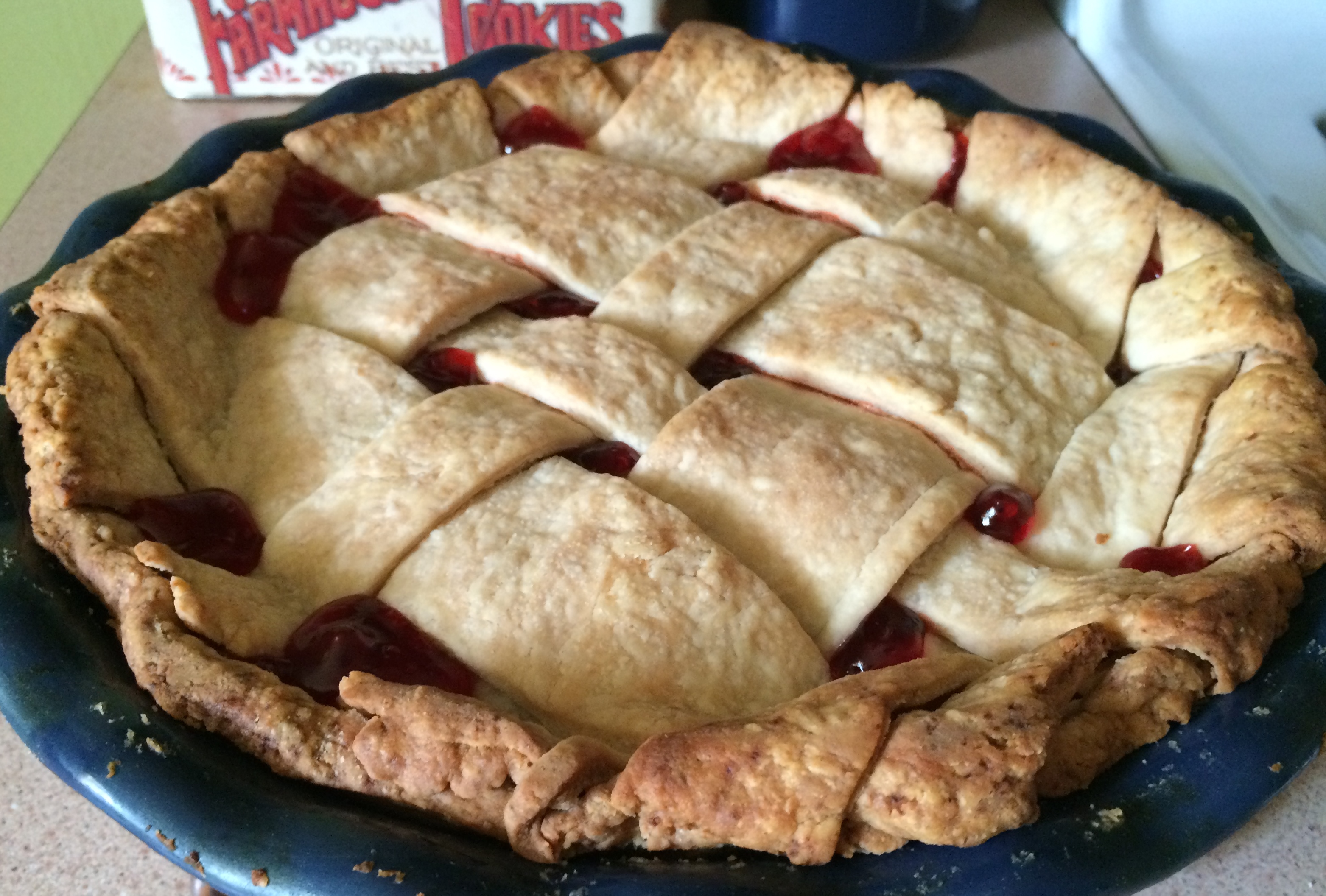
cherry pie with plaid latticeSome time ago, I mastered my mom’s pie crust recipe. While I can make a nice, flaky crust, my crust decoration skills – like latticework and fluted edges – leave a lot to be desired. Today I chose to practice latticework, based on a plaid lattice design I saw from King Arthur Flour. And because I wanted to focus my attention on the crust and not the filling, I used canned pie filling.

That’s right. Canned pie filling. Go ahead and gasp in shock, because you know how I’m a huge proponent of scratch baking and I’ve even blogged about how I couldn’t consider myself a “real” pie baker without being able to make crust from scratch.

Here’s the thing, though…sometimes, in the interest of practicing your lattice work, you want to focus on the crust and not the filling. Or, you really want a pie but your fruit of choice is out of season. Or you simply just don’t have time to peel apples or pit cherries or slice peaches. Most of us use canned pumpkin for our pumpkin pies, don’t we? We’re not roasting pumpkins and scraping out the flesh and spicing it up with cinnamon. Nope, we’re popping open a can and mixing that puree with various sugars and spices.

So, this made me wonder…when did canned pie filling come on the scene in American baking? Probably about the same time that Rosie left her kitchen to become a riveter but was still expected to run a household, pie baking included. Whatever you choose to do, I salute you, fellow pie bakers. If you have any good tips on mastering latticework, please let me know!

Ingredients

Preparation

Preheat oven to 425 degrees.

Prepare pie crusts; line an 8-inch pie plate with one crust and reserve the second crust for the lattice top.

Roll out your second crust, then cut into strips for the lattice. I cut mine into four 2-inch strips and four 1-inch strips.

To make the lattice, place two 2-inch strips and two 1-inch strips onto your filling, alternating two-inch, then one-inch, then two-inch, then one-inch. Fold back half of the strips and lay another 2-inch strip on your filling so that it is perpendicular to the other strips. Fold the other set of strips back so they cover the new strip, then repeat with the remaining strips (again, using the two-inch, then one-inch pattern) to form the lattice. This diagram at King Arthur Flour works very well as a guide for latticework.

Fold the edges of your lattice strips over the edge of your bottom crust and crimp the edges as desired.

Place a pie guard or foil around the edge of your crust and bake for 20 minutes.

Remove the pie guard or foil and reduce oven temperature to 375, then bake for another 30-35 minutes. You may need to place your pie guard back on again for the last 10 minutes of baking.

Remove from the oven and allow to cool before serving.