Poppy Seed Cake

I love retro things, and this poppy seed cake could not look more retro. Perched under the dome of my glass cake stand, it reminds me of something you’d see on the counter of a diner where waitresses dress in aqua-colored uniforms, coffee is fifty cents a cup, and regulars know each other by name.

Adapted from a recipe I found at Taste of Home, which apparently won grand champion at the North Dakota state fair, this cake has amazing texture and absolutely delicious flavor. It’s almost like a moist pound cake, but not as heavy as a pound cake, and flavor-wise the combination of vanilla, almond, and butter extracts is one I’ve never used before but definitely will again. And because it uses oil instead of butter, this cake is incredibly easy to make, requiring only that you mix the ingredients together with a whisk and spoon. It’s one I’ll make many more times in the future.

Ingredients

For the cake

  • 3 cups flour
  • 2 1/2 cups sugar
  • 1 1/2 teaspoons baking powder
  • 1/2 teaspoon salt
  • 3 eggs, at room temperature
  • 1 1/2 cups whole milk
  • 1 cup vegetable oil
  • 1 1/2 teaspoons vanilla extract
  • 1 1/2 teaspoons almond extract
  • 1 teaspoon butter extract
  • 1 tablespoon poppy seeds

For the icing

  • 2 cups powdered sugar
  • 1/2 teaspoon vanilla extract
  • 1/2 teaspoon almond extract
  • 1/2 teaspoon butter extract
  • 3-4 teaspoons orange juice

Preparation

Preheat oven to 350 degrees. Grease and flour a 10-inch Bundt tin.

In a large bowl, combine flour, sugar, baking powder, and salt; set aside. In another large bowl, whisk together eggs, milk, vegetable oil, and extracts. Stir in flour in three batches, mixing to combine completely, then stir in poppy seeds.

Pour batter into prepared tin and bake for 50-60 minutes or until a cake tester comes out clean. Cool in tin for about 15 minutes, then turn out onto a wire rack to cool completely.

To make the icing, combine powdered sugar, vanilla extract, almond extract, butter extract, and 2 teaspoons orange juice; add enough additional juice to make a thick but pourable icing. Pour over cake and allow to drip down the sides. Allow icing to set before serving.

Store in an airtight container at room temperature for several days; this cake stays moist much longer than I expected.

Double Citrus Cupcakes with Italian Meringue Buttercream

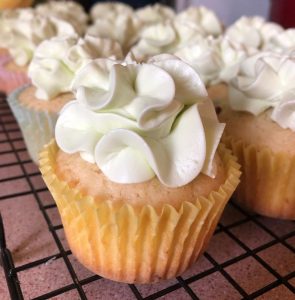
How many types of buttercream are there? Several, as it turns out. American buttercream, with which I have the most experience, is a blend of butter, powdered sugar, and flavorings that yields a smooth and sweet frosting. But there are a few other types out there, and most of them involve meringue. Today, I tried Italian meringue buttercream for the first time, as I had some leftover egg whites from another recipe this week, and I wanted a challenge.

Italian meringue buttercream is frosting that requires you to pour hot syrup down the side of the mixing bowl while whisking egg whites, then whisk the mixture until it’s cool. After that, you switch from the whisk to the paddle attachment and beat in butter one chunk at a time, then continue beating for a while until all the butter is incorporated and you have a silky and yet also fluffy frosting. I read a few blog articles and watched a video at Preppy Kitchen before making mine, and it turned out really well. I’d recommend doing the same; there are some pitfalls with this frosting, and it’s really helpful to know how to navigate them. My recipe below is based on Preppy Kitchen’s recipe, but includes citrus extracts. It’s a mellow frosting that isn’t too sweet, and has a lovely smooth texture.

Ingredients

For the cupcakes

  • 1 1/2 cups flour
  • 1/2 tablespoon baking powder
  • 1 cup sugar
  • 1/4 teaspoon salt
  • 1/4 cup shortening
  • 1 egg
  • 1/2 teaspoon vanilla
  • Zest of 1 lemon
  • Zest of 1 lime
  • 3/4 cup milk

For the Italian meringue buttercream

  • 4 egg whites, at room temperature
  • About 1/4 teaspoon cream of tartar*
  • Pinch of salt
  • 1 1/3 cups sugar, divided
  • 1/3 cup water
  • 1 pound unsalted butter, at room temperature, cut into 1-tablespoon chunks
  • 1 teaspoon vanilla extract
  • 2 teaspoons lemon extract
  • 2 teaspoons lime extract
  • 1-2 drops of yellow and green food coloring

*I followed the Preppy Kitchen blogger John’s recommendation of using three shakes of cream of tartar into my egg whites. Just open your container of cream of tartar and give it three quick shakes over the whites. 

Preparation

Preheat oven to 375 degrees. Line two cupcake tins with paper liners; this recipe yields 17 cupcakes.

In a small bowl, combine flour and baking powder; set aside. In a mixing bowl, cream together sugar, shortening, and salt until fluffy. Add egg, vanilla, and citrus zest; beat until combined. Add flour mixture and milk in alternating batches, starting and ending with the flour and beating until just combined.

Using a 2-inch cookie scoop, drop scoops of batter into the cupcake wells, filling them about half-full. Bake for 15-18 minutes, until a cake tester comes out clean. Remove from oven and remove from tins; allow to cool completely on a wire rack.

To make the Italian meringue buttercream, begin by ensuring that your mixing bowl is clean and fat-residue-free; some people rub a lemon on the surface of the bowl then wipe it out with a paper towel, but I just washed mine well after making the cupcake batter. I also placed my mixer next to my stove for this recipe so I could keep an eye on my egg whites and my syrup at the same time.

Place eggs, cream of tartar, and salt in a mixer fitted with the whisk attachment and mix on low, then medium speed; slowly drizzle in 1/3 cup sugar while whisking. Be careful, as you only need to get your egg whites to soft peaks for the next step – I started my syrup when my egg whites still looked foamy.

While the eggs whisk, place remaining 1 cup sugar and 1/3 cup water in a medium saucepan. Place over medium heat and stir until the sugar dissolves and turns clear; once this happens, stop stirring. Carefully clip a candy thermometer to the side of the pan and bring the mixture to a boil without stirring, heating to 235 degrees (also known as soft-ball stage).

Meanwhile, keep an eye on your egg whites and stop whisking when they’ve reached soft peaks. You can turn off your mixer while you want for the syrup to reach 235 degrees.

Once the syrup is ready, turn your mixer on to low speed and carefully and slowly pour the syrup into your egg whites down the side of the bowl; just aim for the space between the side and the whisk, rather than directly into the whisk itself, so you don’t splash dangerously hot syrup onto yourself.

Once all syrup is added, continue whisking on medium speed until the mixture cools to room temperature; just keep the mixer going and feel the side of the bowl with your hands. Cooling the meringue takes about 15 minutes, depending on how warm your kitchen is. Some people use ice or bags of frozen veggies to help their meringue along, but I just let mine whisk until it was cool.

Once the meringue is cool it will be very smooth, silky, and shiny; remove the whisk attachment and replace with the paddle. Beating on medium speed, slowly add one chunk of butter at a time until the entire pound of butter is incorporated, scraping the sides of your bowl after each stick of butter is added. Your mixture may get runny at first, then start to look curdled, but that’s okay – just keep mixing. Just after you’ve added your last chunk of butter, add extracts and continue to beat for a few minutes more, then add your food coloring and beat to combine for a pale green shade.

The end result of your frosting will look both fluffy at the edges of your bowl, but silky as you run your spatula through it. This sounds really strange, but it’s the best I can do to explain – trust me, you’ll know when it’s done.

Fit a piping bag with a large star tip and fill with frosting; pipe generous swirls onto each cupcake. Store leftover Italian meringue buttercream in a zip-top bag in the freezer for up to 2 months.

Makes 17 cupcakes and enough frosting for at least 2 1/2 dozen cupcakes. Store frosted cupcakes in an airtight container at room temperature for 2-3 days. Chilling Italian meringue will cause the butter to start to appear clumpy in the finished frosting, so I don’t recommend chilling these cupcakes.

King Cake

Every year around Mardi Gras, I plan to bake a king cake. Then I decide not to because they’re essentially bread, and I’m a bread amateur. But this year I bit the bullet and gave it a try, using a recipe from King Arthur Flour that I adapted only to use colored icing, rather than sprinkles, for my yellow, green, and purple decorations. And oh boy, what an experience it was.

Bread amateurs probably either under-work or over-work their dough, and I definitely over-worked mine. Then I baked it for a few minutes too long, so while it smells and tastes delicious, the texture is just all wrong. It’s far too dry, even with a slathering of icing on top. Alas, this can happen when you’re a bread amateur. But the only way to improve one’s bread-making skills is to try again, and so I shall. Just not any time soon!

Note: in addition to reading the recipe, I also read this very useful blog article on King Cake, but only after I’d over-worked my dough. Ah well. 

Ingredients

For the dough

  • 8 tablespoons butter, melted
  • 3/4 cup lukewarm milk (between 98 and 105 degrees)
  • 2 eggs and 1 egg yolk (reserve the white for later), at room temperature
  • 3 1/2 cups flour
  • 1/4 cup sugar
  • 1/4 cup Baker’s Special Dry Milk
  • 1 1/4 teaspoons salt
  • 2 1/2 teaspoons instant yeast
  • 1/4 teaspoon nutmeg
  • 1/8 teaspoon fiori di Sicilia

For the filling

  • 8 ounces cream cheese, at room temperature
  • 1/2 cup sugar
  • 3 tablespoons flour
  • 1 egg, at room temperature, lightly beaten
  • 1/8 teaspoon fiori di Sicilia

For the icing

  • 4 cups powdered sugar
  • 2 teaspoons vanilla extract
  • 5-6 tablespoons milk
  • Yellow, green, and purple food coloring

Preparation

Place the dough ingredients in the bowl of a stand mixer fitted with the paddle attachment and mix on low speed to combine. Once the dough starts to come together, switch to your dough hook and mix on low for 4-5 minutes. Dough will be very soft and sticky.

Transfer to a lightly greased bowl and let rise for about 1 hour. It won’t grow much in size, but should look kind of puffy. Turn dough onto a lightly oiled work surface and stretch and pat it into a 6 x 24 rectangle. Let rest while you prepare the filling.

In a mixer fitted with the paddle attachment, combine cream cheese, sugar, and flour and beat until smooth. Add egg and fiori di Sicilia and beat to combine completely.

Spread filling on the dough, leaving about a 1/2 inch border around the edge. Roll up like you would cinnamon rolls, from the long edge, pinching the seam to seal it. Gently shape your log into a ring and transfer it to a parchment-lined baking sheet. Full disclosure: I had a few holes in my dough, but according to the blog above, this is okay. Cover with lightly greased plastic wrap and allow to rise for about 1 hour.

Preheat oven to 350 degrees. Remove plastic wrap; combine egg white with 1 tablespoon water and brush over the top and sides of the cake. Bake for 20 minutes, then tent with foil and bake another 30 minutes. Remove from oven and allow to cool for about 30-40 minutes before icing.

To making icing, combine powdered sugar, vanilla, and 4 tablespoons water in a medium bowl; add enough additional water to make a thick drizzling icing. Divide in half and pour one half over the cake, allowing it to drip down the sides. Divide the remaining icing into three portions and tint yellow, green, and purple, then drizzle over the cake. Allow icing to set before serving.

Note: I stored my cake in the refrigerator because of the cream cheese filling, but I’m honestly not sure if this is necessary or not. I figured that baked cream cheese was still dairy, and likely needed to be kept in the fridge, but I’m actually going to write to the folks at King Arthur Flour to find out for sure. 

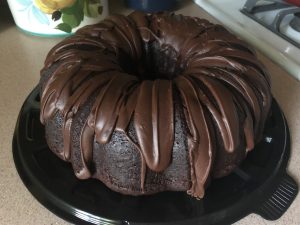
Bourbon Chocolate Bundt Cake

Sometimes I wonder how certain etiquette standards began. Like when someone passes away, family, friends, and neighbors bring food to the bereaved. Perhaps people wanted to support their loved ones and make the days following a loss easier, and not having to cook – or worry about refreshments to serve to visitors paying respects – was a kind way of doing that. And here we are, so many years later in human history, still doing that very same thing.

This cake is en route to Maryland with Mike today, as he travels to Annapolis to celebrate the life of his Uncle Haysie, who passed away earlier this week. Haysie was married for 45 years to Mike’s very dear Aunt Wendy, one of my absolute favorite in-laws. They were a wonderful couple, and I’m hoping this bourbon chocolate cake with make her smile.

Ingredients

For the cake

  • 3 ounces unsweetened baking chocolate, chopped
  • 2 ounces sweetened baking chocolate, chopped
  • 2 cups flour
  • 1 teaspoon baking soda
  • 1/2 teaspoon salt
  • 1 cup butter, at room temperature
  • 2 cups sugar
  • 3 eggs, at room temperature
  • 1 1/2 teaspoons vanilla extract
  • 1/4 cup instant coffee crystals
  • 2 tablespoons boiling water
  • About 1 1/2 cups cold water
  • 1/2 cup plus 2 tablespoons bourbon, divided

For the glaze

  • 2 tablespoons butter, melted
  • 3 tablespoons cocoa powder
  • 1 1/4 cups powdered sugar
  • 2-3 tablespoons warm water
  • 1/2 tablespoon bourbon

Preparation

Preheat oven to 325 degrees. Thoroughly butter a 10-inch Bundt pan and dust with cocoa powder, tapping out the excess.

In a microwave-safe bowl, combine chopped unsweetened and sweet baking chocolate. Microwave, uncovered, for 1 minute, then stir; continue microwaving in 15-30 second intervals and stirring until chocolate is completely melted. Set aside to cool slightly.

In a medium bowl, combine flour, baking soda, and salt; set aside.

In a mixer fitted with the paddle attachment, cream butter and sugar together until light and fluffy. Add eggs, one at a time, beating and scraping down the sides of the bowl between each addition. Beat in melted chocolate and vanilla extract.

In a 2-cup glass measuring cup, combine coffee crystals and boiling water; add enough cold water to bring the total liquid to 1 1/2 cups, then stir in the 1/2 cup bourbon.

Add flour mixture and coffee mixture to chocolate mixture in alternate batches, beginning and ending with the flour, and beating until just combined after each addition. You’ll want to scrape down your bowl a few times during the process.

Pour batter into prepared Bundt pan and bake for 55-60 minutes, until a cake tester comes out clean; I covered my cake around 45 minutes of baking to prevent over-browning. Remove from oven and allow to cool in the pan for about 15 minutes.

Turn cake out onto a wire rack and brush the top and sides with 2 tablespoons bourbon. Allow to cool completely before glazing.

To make the glaze, combine melted butter, cocoa powder, powdered sugar, and 2 tablespoons water in a bowl and stir until smooth; add bourbon and stir completely to combine. If your glaze is too thick, you can add one more tablespoon of water; I wanted a thicker glaze so I just used 2. Using a spoon, drizzle glaze over the cake; allow to set.

Store in an airtight container at room temperature for up to 2 days.

Strawberry Krispie Treats

Breaking news (or maybe I’m just wildly behind on my cereal information): Rice Krispies now come in strawberry. You’re welcome, America.

Seriously though, they are delicious. And they made the perfect Valentine-themed treat for my favorite little Maryland girls, Mo and Margo, this week. Off they shipped, carefully tucked into a container lined with waxed paper so, I hope, they didn’t arrive in one enormous lump. This recipe, which I found at Cookies and Cups and simply adapted to use strawberry Krispies instead of regular, was incredibly easy to make. They’re an extra-marshmallowy variety, which I find ships better than standard recipes.

Ingredients

  • 5 tablespoons unsalted butter
  • 1/2 teaspoon kosher salt
  • 10 cups miniature marshmallows
  • 6 cups Strawberry Krispies

Preparation

Line a 9 x 9 pan with foil, extending the foil over the sides, and lightly spray with vegetable oil.

In a large pot, melt butter and salt over medium heat. Add 8 cups miniature marshmallows, stirring until completely melted. Remove from heat and stir in Krispies, coating completely, then stir in remaining 2 cups miniature marshmallows.

Press mixture into prepared pan and smooth out the top to create an even layer using a spatula that’s coated in vegetable oil spray. Allow to cool to room temperature; once completely cool, lift out of pan and cut into squares.

Makes 16.

Chocolate Charms

My nephew Roman is a big fan of store-bought chocolate cookies like Oreos. While he loves my chocolate cake, these chocolate charms – essentially like a chocolate shortbread, weren’t his favorite. I sent this shipment to North Carolina for his Valentine’s Day gift, and he apparently ate one and said, eh, I don’t like this. Fortunately my brother and sister-in-law both loved them, so it’s not a loss.

The original recipe for these treats comes from the Martha Stewart Living Cookie book and calls for a dusting of cocoa powder before serving. As I shipped these, I left them un-dusted, but I actually thought the next time I make them I’d like to dip them in a cocoa icing. We’ll see how that goes.

Ingredients

  • 2 cups flour
  • 1/4 cup cocoa powder
  • 1/4 teaspoon salt
  • 1 cup butter, at room temperature
  • 3/4 cup sugar
  • 1 teaspoon vanilla extract

Preparation

Sift together flour, cocoa powder, and salt in a medium bowl; set aside.

In a mixer fitted with the paddle attachment, beat butter on medium speed until fluffy, about 3-4 minutes. Add sugar and beat on medium for 3-4 minutes more, then add vanilla extract. Beat in flour/cocoa mixture until dough is just combined, scraping the sides of the bowl a few times. The dough may be just a bit crumbly, but should hold together when you squeeze it.

Turn dough out onto a piece of plastic wrap and flatten into a rough disc, then chill for about 1 hour.

Preheat oven to 325 degrees. Line two baking sheets with parchment. Break off 1-inch pieces of dough and roll into balls, then place on the parchment-lined baking sheet. Bake for 20 minutes, rotating the sheet about halfway through. Cool for a few minutes on the baking sheet, then remove to a wire rack to cool completely.

Store in an airtight container for about 1 week. If desired (and not shipping), dust with cocoa powder before serving. Makes about 2 1/2 dozen.

Cream Scones

Mike and I traveled to England about 13 years ago, and I spent a great deal of time there drinking tea and enjoying classic British baked goods. That trip marked the first time I had a British scone, a wedge of millionaire’s shortbread, and digestive biscuits (which, incidentally, are absolutely delicious despite how they might sound).

That first scone, served alongside a pot of tea with strawberry jam and cream, reminded me more of an American biscuit but slightly more cakey. You can make scones with heavy cream or buttermilk and butter, but the heavy cream version will turn out more cakey, and I suspect those scones were the cream kind. This recipe came from Baking Mischief, though I did need just a bit more heavy cream than the recipe originally included. As I read in my King Arthur Flour Baker’s Companion, flour can be dry in the winter, so sometimes you might need a bit more liquid in a scone recipe as a result. This recipe yields a small batch of just six scones, but you could easily double it for a larger batch.

Ingredients

  • 1 1/2 cup (180 grams) flour, measured by the scoop-and-sweep method or by weight (I measured by weight)
  • 3 tablespoons sugar
  • 1 1/2 teaspoons baking powder
  • 1/2 teaspoon salt
  • 3/4 cup plus 1 tablespoon heavy cream*
  • 1/2 teaspoon vanilla

*You’ll need a bit more heavy cream to brush on top of the scones, probably about 1-2 tablespoons total.

Preparation

Preheat oven to 425 degrees. Line a baking sheet with parchment paper.

In a large bowl, whisk together flour, sugar, baking powder, and salt. Combine vanilla and heavy cream and drizzle over flour mixture, stirring gently to combine. You want a “shaggy” dough, with no loose flour at the bottom of the bowl, but the dough should not be sticky.

Gently shape the dough into a ball and turn out onto a lightly floured counter top. Press the dough into a disc about 5 1/2 inches wide.

Using a knife or bench scraper, cut the dough into 6 wedges. Transfer to a baking sheet, placing the wedges in a circle with about 1 inch between them. Brush the tops and sides with heavy cream to help them brown.

Bake for 14-16 minutes, until light golden brown on top; I used a cake tester on one scone to make sure the center was baked through. Remove from oven and allow to cool for just a few minutes; serve warm. Store any leftovers in an airtight container at room temperature; warm before serving.

Makes 6.


Mocha Cupcakes

Sometimes I wonder who came up with different flavor combinations, like coffee and chocolate. Although I live a caffeine- and chocolate-free life, mocha is still a delicious flavor, and it’s really nice to bake with for the heavenly aroma that floats around my kitchen. Mocha also reminds me of tiramisu, my absolute favorite dessert, which I still eat despite its migraine risk. I figure that a tiramisu-triggered migraine would be totally worth it…but fortunately, I haven’t had one from it. Fingers crossed that this remains true for the rest of my life.

These mocha cupcakes are adapted from a recipe I found at Brown Eyed Baker, another Pittsburgh-based baking blog. Although I didn’t have whole milk, which the original recipe required, I used an interesting combination of 7/8 skim to 1/8 heavy cream. I added heavy cream to the frosting as well, along with more espresso powder than the original recipe…and let me tell you, it is crazy delicious. I could actually see it as a nice complement to plain chocolate cupcakes, or even the right vanilla cupcake. These treats were very well-received at work this week.

Ingredients

For the cupcakes

  • 1/2 cup coffee, at room temperature
  • 1 1/2 teaspoons espresso powder
  • 1/2 cup milk*
  • 1 teaspoon vanilla extract
  • 1 1/3 cups flour
  • 1/3 cup cocoa powder
  • 1 teaspoon baking powder
  • 1/2 teaspoon baking soda
  • 1/4 teaspoon salt
  • 8 tablespoons unsalted butter, at room temperature
  • 1/2 cup granulated sugar
  • 1/2 cup light brown sugar
  • 1 egg, at room temperature

*As noted above, the original recipe calls for whole milk, but I only had skim and heavy cream on hand, which I used in a 7/8 skim, 1/8 heavy cream ratio.

For the frosting

  • 1 cup butter, at room temperature
  • 2 1/2 cups powdered sugar
  • 3 1/2 teaspoons espresso powder
  • 1 1/2 teaspoons vanilla extract
  • 2 teaspoons heavy cream

Preparation

Preheat oven to 350 degrees. Line two 12-cup muffin tins with paper liners; my recipe yielded 18 cupcakes.

In a medium-sized glass measuring cup, whisk together coffee and espresso powder until the powder is completely dissolved. Add milk and vanilla and stir to combine, then set aside.

In a medium bowl, stir together flour, cocoa powder, baking powder, baking soda, and salt; set aside.

In a mixer fitted with the paddle attachment, cream the butter and sugars until light and fluffy, about 3 minutes. Add egg and mix to combine, scraping down your bowl at least once. Add flour mixture and coffee/milk mixture in alternate batches, starting and ending with the flour and mixing just to combine between each. Stir with a spatula to ensure that all the flour mixture is incorporated.

Using a two-inch cookie scoop, drop scoops of batter into the cupcake wells, filling each about two-thirds full. Bake for 17-20 minutes, until a cake tester inserted in the center comes out clean. Remove from oven, then remove cupcakes from tin and cool completely on a wire rack.

To make the frosting, combine espresso powder, vanilla extract, and heavy cream in a small bowl and stir to completely dissolve the espresso powder. Beat butter on medium speed for about 2 minutes, then add powdered sugar all at once and beat until the sugar is fully incorporated into the butter. Add espresso mixture and beat 2-3 minutes until completely combined; you’ll want to scrape your bowl a few times in the process.

Fit a large piping bag with a Wilton M1 tip and pipe swirls of frosting on each cupcake. Store in an airtight container at room temperature for 2-3 days.

Honey Almond Cake

I bought myself Mary Berry’s Fast Cakes: Easy Bakes in Minutes cookbook for my birthday last summer, and I’m working my way through the British baking queen’s many recipes. I’ve made several adjustments based on ingredients we have available here in the U.S., tweaked the preparation to accommodate those changes, and also swapped out a few ingredients to better suit my tastes.

For example, most of the cakes in this book call for margarine and use the all-in-one method, where you toss all of the ingredients into the mixer and blend it all at once. For this cake, I chose to use butter, and therefore also the creaming method, for this cake because I simply prefer the taste of butter-based cakes to margarine-based ones. The end result is delicious, not too sweet, and a great size for a small dinner party or get-together. It’s the kind of cake you could make if you want a cake, but not a standard-sized, what-am-I-going-to-do-with-all-the-left-overs kind of treat. Note: I found the deep, 7-inch round baking tin on Amazon.

Ingredients

For the cake

  • 10 tablespoons butter, softened
  • 1/2 cup light brown sugar
  • 2 tablespoons honey
  • 3 eggs
  • 1 1/4 cups self-rising flour
  • 3/4 cup almond flour
  • 2 tablespoons milk
  • 1 teaspoon almond extract

For the frosting and topping

  • 8 tablespoons butter, softened
  • 2 1/2 cups powdered sugar, sifted
  • 4 tablespoons honey
  • 2 1/2 teaspoons almond extract
  • 1/2 cup slivered almonds, toasted and cooled

Preparation

Preheat oven to 320 degrees. Lightly grease a deep, 7-inch round cake tin and line the base with parchment paper.

In a mixer fitted with the paddle attachment, cream together butter and light brown sugar until light and fluffy. Add honey and blend to combine, then add eggs, one at a time, beating well and scraping the sides of the bowl between each addition. Add self-rising flour and almond flour, then milk and almond extract, and beat to combine until you have a smooth batter.

Pour batter into prepared tin and bake for 40-45 minutes, until well risen and the top of the cake springs back when lightly pressed with your finger.

Remove from oven and allow to cool for about 10 minutes, then turn onto a wire rack and cool completely. Once cake has cooled, slice in half horizontally.

To make the frosting, combine butter and powdered sugar in a mixer fitted with the paddle attachment and mix until the sugar has been fully incorporated into the butter. Add honey and almond extract and beat until smooth and fully combined.

Spread frosting on bottom layer of cake and top with the second layer; frost the top and sides of the cake, then top with toasted slivered almonds.

Store in an airtight container at room temperature for 2-3 days. Makes about 8 servings.

Blood Orange Madeira Cake

My appreciation for blood oranges is well documented on this blog. Both beautiful and tasty, they make great additions to baking. And because I’ve been on vacation since Christmas (I have to go back to work tomorrow, sigh) and I’ve been watching a lot of Great British Baking Show re-runs, I realized that one perfect use for blood oranges would be in Madeira cake. And I was right.

I adapted my previous Madeira cake recipe to use a 9 x 5 (rather than an 8 x 4) loaf tin and included the zest and juice of two blood oranges instead of just one. The end result is a delicious, aromatic creation that needs absolutely nothing to enhance it, though you could certainly serve it with some whipped cream if you like.

Ingredients

  • 2 1/2 cups flour
  • 1 1/2 teaspoons baking powder
  • 1/4 teaspoon kosher salt
  • 1 142 cups unsalted butter, at room temperature (2 1/2 sticks)
  • 1 cup plus 2 tablespoons sugar, divided
  • Zest of 2 blood oranges
  • 3 eggs, at room temperature
  • Juice of 2 blood oranges

Preparation

Preheat oven to 325 degrees. Grease a 9 x 5 loaf tin, then line the tin with parchment.

In a medium bowl, whisk together flour, baking powder, and salt; set aside. In a mixer fitted with the paddle attachment, cream butter, sugar, and orange zest until light and fluffy, about 3-5 minutes, scraping the bowl well at least a few times.

Add the first egg and one spoonful of flour mixture, beating to combine. Scrape down the bowl, then repeat with remaining eggs and one spoonful of flour mixture for each egg, scraping the bowl between each. Add remaining flour and orange juice and mix until combined; batter will be quite thick.

Spoon batter into the pan and smooth out the top, then sprinkle the remaining 2 tablespoons of sugar over the top. Bake for about 45 minutes, then cover with foil and continue baking for another 10-20 minutes, until a cake tester inserted in the center comes out clean. Cool in pan completely, then lift out by the parchment and store, well wrapped, at room temperature. Makes about 10 servings.