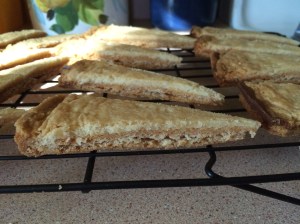
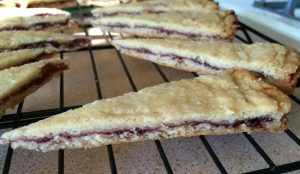
Almond-Filled Shortbread

almond-filled-shortbreadShortbread filled with almond paste? Yes, it is just as delicious as it sounds.

While experimenting with raspberry-filled shortbread last weekend, I decided to take the advice of the incredibly talented bakers at King Arthur Flour and fill my second shortbread round with almond paste. The result is a sturdier cookie than the jam-filled variety, and now I have to wonder…what would happen if I put both almond paste and jam into the same shortbread round? We’ll save that experiment for another day.

Ingredients

  • 1 cup unsalted butter, slightly softened
  • 1 teaspoon salt
  • 3/4 cup sugar
  • 1 teaspoon vanilla extract
  • 10 ounces flour (about 2 1/3 cups; I used a food scale to measure mine)
  • 1 cup almond paste

Preparation

Preheat oven to 300 degrees.

In a mixing bowl, cream together butter, sugar, salt, and vanilla, then beat in flour.

Divide dough into four pieces, about 6 ounces each (I’d recommend 5.7 or 5.8 ounces each to divide as evenly as possible).

Place an 8-inch round cake pan upside down on your counter top and cover with plastic wrap. Press one portion of dough onto the plastic wrap, covering the bottom of the pan completely – you’ll need to be careful, as the dough can tear as it stretches. Wrap the circle of dough in the plastic wrap and refrigerate while repeating this step with each remaining portion.

Gently knead your almond paste, then divide it into two portions. On a lightly floured surface, roll out your paste into a circle about 7 1/2 inches wide.

Lightly grease two 8-inch round cake pans; remove dough circles from the fridge. Peel plastic wrap off the first circle of dough and press into the bottom of one cake pan; top with almond paste, leaving about 1/2 inch bare border around the edges. Top with another circle of dough and gently press the edges to seal them. Prick all over with a fork all the way through each layer. Repeat with the third and fourth circles of dough in the other pan.

Bake for 45 minutes, until golden brown. Remove from oven and loosen the sides with a knife, then cool in pans for 10 minutes.

Carefully turn the shortbread out onto two cutting boards and allow to cool for 5 minutes, then cut into wedges. I cut mine into 16 wedges each for slimmer slices.

Makes 32 wedges.

Raspberry-Filled Shortbread

raspberry-filled-shortbreadThe people at King Arthur Flour are baking geniuses. Who else but a genius would come up with delicious buttery shortbread filled with raspberry jam?

This recipe comes from the King Arthur Flour Cookie Companion, my new favorite book. While the preparation does take a bit of time, the end result is totally worth it. You could use any jam with this, and I look forward to making other batches with apricot and strawberry in the future. The recipe below yields two 8-inch rounds of shortbread, so you could use one flavor of jam in one round and a different flavor in the other if you like. When I originally baked this last weekend, I made one round with jam and the other with almond paste; both were tasty, but the jam version was my favorite.

Ingredients

  • 1 cup unsalted butter, slightly softened
  • 1 teaspoon salt
  • 3/4 cup sugar
  • 1 teaspoon vanilla extract
  • 10 ounces flour (about 2 1/3 cups; I used a food scale to measure mine)
  • 6 tablespoons raspberry jam*

*If you’re making one round with raspberry and the other round with a different type of jam or with almond paste, you only need 3 tablespoons of jam.

Preparation

Preheat oven to 300 degrees.

In a mixing bowl, cream together butter, sugar, salt, and vanilla, then beat in flour.

Divide dough into four pieces, about 6 ounces each (I’d recommend 5.7 or 5.8 ounces each to divide as evenly as possible).

Place an 8-inch round cake pan upside down on your counter top and cover with plastic wrap. Press one portion of dough onto the plastic wrap, covering the bottom of the pan completely – you’ll need to be careful, as the dough can tear as it stretches. Wrap the circle of dough in the plastic wrap and refrigerate while repeating this step with each remaining portion.

Lightly grease two 8-inch round cake pans; remove dough circles from the fridge. Peel plastic wrap off the first circle of dough and press into the bottom of one cake pan; top with jam, leaving about 1/2 inch bare border around the edges. Top with another circle of dough and gently press the edges to seal them. Prick all over with a fork all the way through each layer. Repeat with the third and fourth circles of dough in the other pan.

Bake for 45 minutes, until golden brown. Remove from oven and loosen the sides with a knife, then cool in pans for 10 minutes.

Carefully turn the shortbread out onto two cutting boards and allow to cool for 5 minutes, then cut into wedges. I cut mine into 16 wedges each for slimmer slices.

Makes 32 wedges.


Cinnamon Caramel Swirl Shortbread

cinnamon-caramel-swirl-shortbreadCinnamon and caramel, together in shortbread? Trust me…it’s delicious. This is my second recipe from the King Arthur Flour Cookie Companion and it is, as promised, a surprisingly tasty result from an unexpected flavor pairing.

Shortbread is easy to make; you just need a few ingredients, and you can dress it up any way you like. In this case, we combine cinnamon and caramel, two flavors that don’t often go together but in this case work perfectly.

Just a few things to note about this recipe: I measured my flour by weight, using a food scale, rather than by volume this time. You’ll need 10 ounces of flour, which comes out to about 2 1/3 cups if you use the method recommended by the King Arthur Flour folks, which involves stirring up your flour to aerate it, then scooping it into your measuring cup with a spoon and leveling it. Also, I recommend drizzling each individual wedge on its own, rather than drizzling your entire cooling rack’s worth of wedges in long sweeps at once. The caramel cools fairly quickly, forming strings between the wedges that you have to cut with a knife to separate.

Ingredients

  • 1 cup sugar, divided
  • 1 tablespoon cinnamon
  • 1 cup butter, slightly softened
  • 1 teaspoon salt
  • 1 teaspoon vanilla extract
  • 10 ounces (about 2 1/3 cups) flour
  • 16 vanilla caramel candies
  • 1 tablespoon heavy cream

Preparation

Preheat oven to 300 degrees. Lightly grease two 9-inch round baking pans.

In a small bowl, combine 1/4 cup sugar and cinnamon; sprinkle the bottom of each pan with 1 tablespoon cinnamon sugar.

In a mixer fitted with the paddle attachment, cream together butter, salt, 3/4 cup sugar, and vanilla extract until fluffy. Add flour and beat to combine.

Divide dough in half and press into prepared pans, smoothing the tops with your fingers or the bottom of a measuring cup to create a smooth surface. Sprinkle the top of each round of dough with remaining cinnamon sugar, then prick the surface with a fork in whatever pattern you like.

Bake for 35-40 minutes, until edges are golden brown. Remove from oven and loosen the sides with a knife, then cool in pans for 5 minutes.

Carefully turn the shortbread out onto a cutting board and cut into wedges; I cut mine into 16 wedges each. Cool wedges completely on a wire rack.

In a small saucepan, combine vanilla caramel candies and heavy cream, stirring until the caramels melt and the mixture is smooth. Drizzle each wedge with caramel; if the caramel becomes too thick to drizzle, return it to the heat briefly to soften it.

Allow caramel to set before storing, and store at room temperature in an airtight container between layers of waxed paper.

Makes 32 wedges.

Scandinavian Blondies

scandanavian-blondiesMike gave me the King Arthur Flour Cookie Companion for my birthday. Next to Boarman, the stone pig that my mom gave me last Christmas for our backyard, it’s my favorite gift I’ve ever gotten.

The Cookie Companion is a cookie baker’s bible, featuring variations on essentials from sugar cookies to bars and everything in between. I can honestly say that I intend to bake each recipe in its 400+ pages; with each one I read, I learn something new that I cannot wait to try.

These bars are adapted from the original King Arthur Flour recipe; I added lemon extract and lemon zest to the batter. They are delicious, both cakey and chewy, with a wonderful lemon almond flavor. If you’re not a lemon fan, you can skip the lemon altogether and just go with the traditional almond extract in the batter, or use a combination of almond and vanilla extracts.

Ingredients

  • 2 eggs
  • 1 cup sugar
  • 1/2 teaspoon salt
  • 1/2 teaspoon almond extract
  • 1/2 teaspoon lemon extract
  • zest of 1 medium lemon
  • 8 tablespoons butter, melted
  • 1 cup flour
  • 1/2 cup sliced almonds

Preparation

Preheat oven to 325 degrees. Lightly grease an 8 x 8 square baking pan.

In a mixer fitted with the paddle attachment, beat eggs until light colored and thick. Add sugar and salt, continuing to beat until shiny and pale yellow.

Add extracts, zest, melted butter, and 1/2 cup of the flour, folding in gently. Fold in remaining 1/2 cup of flour.

Pour batter into prepared pan and sprinkle with sliced almonds.

Bake for 30-35 minutes, until the edges begin to pull away from the sides of the pan and are a very light golden color.

Remove from oven and cool in pan before cutting. Store at room temperature.

Makes 16 bars.

Pecan Mandelbrot

pecan-mandelbrotMandelbrot is similar to biscotti, a twice-baked creation that means “almond bread” in Yiddish. Technically speaking, this mandelbrot has no mandel, though I suspect that using almonds in this would also be delicious.

Mandelbrot is slightly softer than biscotti due to its higher vegetable oil content, but the premise is the same – bake the logs, let the logs cool for a few minutes, then quickly slice the logs and bake the slices a second time. While this might sound like a lot of work, it’s actually very easy to do, and it yields a large quantity – about 3 1/2 dozen – so it’s good for a crowd.

This recipe is adapted just slightly in preparation from Martha Stewart’s Cookies, a reliable source for excellent recipes. My kitchen smelled absolutely delicious when I made this on Labor Day, and the treats were a big hit in Mike’s office this week.

Ingredients

  • 3 cups flour
  • 1 teaspoon baking powder
  • 1 teaspoon baking soda
  • 3/4 cup vegetable oil
  • 1 1/4 cups sugar, divided
  • 3 eggs
  • 3/4 teaspoon kosher salt
  • 1 teaspoon vanilla extract
  • 1 cup chopped pecans, toasted and cooled
  • 1 teaspoon ground cinnamon

Preparation

Preheat oven to 350 degrees. Line a baking sheet with parchment paper.

In a small bowl, combine 1/4 cup sugar and cinnamon; set aside.

In a medium bowl, combine flour, baking powder, and baking soda; set aside.

In a mixing bowl fitted with the paddle attachment, combine vegetable oil, 1 cup sugar, eggs, salt, and vanilla extract. Beat on medium-low speed until combined.

Scrape your bowl well and with the mixer running on low, slowly add the flour mixture, beating until combined. Stir in pecans.

Turn dough onto a very lightly floured counter top. With floured hands, divide dough into three portions and shape each into a log about 3 inches wide and 1 inch high.

Place on baking sheets, leaving room between each log; they will spread during baking.

Bake for 30-35 minutes, until golden and puffed, but firm to the touch. Remove from oven and allow to cool for 3 minutes. In the meantime, line a second baking sheet with parchment paper.

Place each log on a cutting board and, working quickly to prevent the logs from cracking too much, slice into 1/2 inch slices. Return slices to baking sheets and sprinkle with cinnamon sugar; bake for 7 minutes.

Remove from oven, then flip slices over and sprinkle the other side with cinnamon sugar; bake for 7 minutes more.

Allow to cool on baking sheets for about 5 minutes, then remove to a wire rack to cool completely.

Store in an airtight container for up to 1 week.

Vanilla Bean Sandwich Cookies

vanilla-bean-sandwichesPeople cultivate vanilla in many parts of the world, but my favorite vanilla comes from Mexico. Vanilla is actually a member of the orchid family, and has been grown in eastern Mexico – where it was first cultivated – for hundreds of years.

If you’ve never worked with a vanilla bean before, don’t be afraid. Simply place your bean on a cutting board and split the bean in two lengthwise – I use a small chef’s knife for both the splitting and the scraping. Flatten out the halves so the inside of the bean faces up, then scrape your knife down each of the insides to get the seeds, which will look like a black paste.

This recipe is adapted from two different ones from Martha Stewart’s Cookies, a book I’ve used many times with great success. I ended up with an extra half-cup of filling, so next time I might pare down my filling recipe to make less.

Vanilla Bean Cookies

Ingredients

  • 1 3/4 cups flour
  • 1 teaspoon baking soda
  • 1/2 teaspoon kosher salt
  • 10 tablespoons butter, at room temperature
  • 1 1/2 cups sugar
  • 1 egg
  • 2 teaspoons vanilla extract
  • 1 vanilla bean, halved and scraped

Preparation

Preheat oven to 350 degrees. Line three baking sheets with parchment paper.

In a medium bowl, whisk together flour, baking soda, and kosher salt; set aside.

In a mixer fitted with the paddle attachment, cream butter and sugar until light and fluffy, about 2 minutes.

Add egg, vanilla extract, and vanilla seeds and beat on medium speed until smooth.

With the mixer running on low, gradually add flour mixture.

Using a 1-inch cookie scoop, drop scoops of dough onto prepared baking sheets about 2 inches apart.

Bake for 8-12 minutes, rotating the baking sheets halfway through, until tops are very light golden and just set.

Cool on baking sheets for 2-3 minutes, then transfer on the parchment to wire racks to cool completely before filling.

Vanilla Cream Filling

Ingredients

  • 8 tablespoons butter, softened
  • 1/2 cup shortening
  • 3 1/2 cups powdered sugar
  • 1 tablespoon vanilla extract

Preparation

In a mixing bowl, beat together butter and shortening.

Add powdered sugar in small batches, beating until combined.  Once all sugar is incorporated, beat on medium speed for two minutes

Add vanilla and beat to combine.

Using a one-inch cookie scoop, drop scoops of filling onto half of the cookies.  Spread filling to the edges, then top with another cookie.

Makes 18 sandwiches.

Lemon Raspberry Cupcakes

lemon raspberry cupcakesSummer is coming to an end, but you wouldn’t know it by the weather in Pittsburgh today. It’s in the 90s, with humidity through the roof. And when I think of summer flavors – fitting for a day like this – I think of lemon and raspberry.

These cupcakes are a delightful blend of sweet and tart, combining a lemon cupcake with raspberry filling and lemon buttercream frosting. The most labor-intensive part of this recipe is the straining of the raspberry filling; in order to get a seedless result, you’ve got to spend several minutes pressing the mixture through a fine sieve. You could certainly buy raspberry filling at your local baking supply shop if you’d like to save time, but there’s something very rewarding about making your own.

 Raspberry Filling

Ingredients

  • 12 ounces raspberries, mashed
  • 1 1/2 cups powdered sugar
  • 4 teaspoons cornstarch
  • 2 teaspoons lemon juice

Preparation

In a medium saucepan, stir together raspberries, powdered sugar, cornstarch, and lemon juice. Cook over medium heat until the mixture boils, then allow it to boil for 1 minute, stirring well, until the mixture thickens.

Remove from heat and press through a fine sieve to filter out the seeds. Allow to cool before using; makes about 1 cup. Once you fill your cupcakes, you’ll have a small amount of filling left over that you can use as you like.

Lemon Cupcakes

Ingredients

  • 1 1/4 cups flour
  • 1 1/4 teaspoons baking powder
  • 1/4 teaspoon salt
  • 6 tablespoons butter, slightly softened
  • 1/2 cup plus 6 tablespoons sugar
  • 1/2 teaspoon vanilla extract
  • 1/4 teaspoon lemon extract
  • 1 egg
  • zest of 1 medium lemon
  • 1/2 cup plus 2 tablespoons milk

Preparation

Preheat oven to 375 degrees. Line two 12-inch muffin ups with paper liners; this recipe made 17 cupcakes for me.

In a medium bowl, stir together flour, baking powder, and salt; set aside.

In a mixing bowl, cream together butter, sugar, vanilla extract, and lemon extract. Add egg and beat well, scraping the sides of the bowl as necessary. Add lemon zest and beat until combined.

Add flour mixture and milk alternatively, in three batches, beating until combined.

Using a 2-inch cookie scoop, scoop batter into prepared muffin tins, filling about half full.

Bake for 15-20 minutes, until a cake tester comes out clean.

Cool completely before filling and frosting.

Lemon Buttercream

Ingredients

  • 12 tablespoons butter, at room temperature
  • 2 1/2 to 3 cups powdered sugar
  • 1 1/2 tablespoons lemon juice
  • 3/4 teaspoon lemon extract

Preparation

In a mixing bowl, beat butter on medium speed for about 2 minutes.

Scrape down the sides of the bowl, then add powdered sugar and beat on low speed until fully incorporated, about 3-4 minutes.

Add lemon juice and lemon extract and beat on medium speed for 2-3 minutes, until fluffy.

To assemble the cupcakes:

Using the small end of a melon baller, scoop out a small amount of cake from the center of each cupcake; reserve for a trifle or another use.

Fit a piping bag with a large plain tip; twist the tip end of the bag so the filling doesn’t start to run out when you pour it in. Fill the bag, then carefully pipe filling into each cupcake.

Fit a 14-inch piping bag with a Wilton M1 tip and pipe swirls of frosting onto each cupcake.

Store in an airtight container at a cool room temperature for up to 3 days.

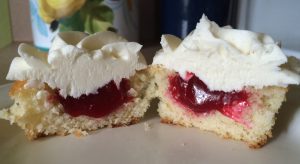
lemon raspberry cupcakes 2Here’s a look inside the cupcakes.

Cherry Frosting

cherry limeade cupcakesThis frosting, which I first used on cherry limeade cupcakes, could work very well on vanilla, lemon, or chocolate cupcakes. Because it uses the juice from maraschino cherries, it’s a good option for year-round baking, and you can always add the cherries themselves to top your cupcakes or cake if you like.

This recipe yields enough for at least 18 cupcakes, but I believe it could frost about 2 dozen if you use more modest portions on each cupcake than I used on my cherry limeade cupcakes. The recipe can be easily doubled to cover two-layer cakes or sheet cakes.


Ingredients

  • 8 tablespoons unsalted butter, at room temperature
  • 4 cups powdered sugar
  • 1/2 teaspoon almond extract
  • 1/4 cup plus 3 tablespoons maraschino cherry juice

Preparation

Beat butter in a mixing bowl for 1-2 minutes. Add 3 cups powdered sugar and allow the sugar to fully incorporate into the butter; this will take several minutes.

Add almond extract and 1/4 cup cherry juice; beat on medium speed for 2-3 minutes, then add another cup of powdered sugar and additional juice. Beat on medium speed for another 2-3 minutes.

Lime Curd

vanilla lime cupcakesWe have lemon curd, so why not lime? I used Martha Stewart’s key lime curd recipe and adapted it using regular limes. I was also surprised to see that this recipe doesn’t require tempering some of the lime mixture into the eggs, then returning the tempered mixture back into the pan for further cooking, like you do with lemon curd.

It does take a while for this mixture to reach the right consistency, so prepare to stand at your stove for about 12-15 minutes. The end result is absolutely worth it, though. You can use this curd in vanilla lime cupcakes, coconut cupcakes, or whatever else your heart desires.

Ingredients

  • 1/2 cup sugar
  • 2 large eggs
  • zest of 1 lime
  • 1/4 cup lime juice (about 2 medium limes)
  • 4 tablespoons butter, cut into small pieces

Preparation

Place a bowl and sieve next to your stove for easy access once your curd is cooked.

In a medium saucepan, whisk together sugar, eggs, lime zest, and lime juice. Cook over medium-low heat, whisking constantly, until the mixture holds the shape of the whisk – this will take about 12-15 minutes.

Remove from heat and whisk in butter a few pieces at a time until butter completely melts.

Strain the curd through your sieve and press a piece of plastic wrap directly onto the surface to prevent a skin from forming.

Chill for about 3 hours before using; I chilled mine overnight.

Brown Sugar Butterscotch Cake

brown sugar butterscotch cakeI’m the kind of woman who bakes her own birthday cake. This year, I wanted a brown sugar cake with butterscotch, and so I made one.

Homemade butterscotch is easier to make than you might think. Mine turned out thicker than I expected this time, probably because I cooked it over higher heat than I should have. Since my sauce ended up thicker and less appropriate for drizzling over the top of my cake, I remedied it by stirring in some heavy cream to thin it out – and it worked very well.

This recipe yields about 3 1/2 cups of batter, which made one 8-inch round cake and two cupcakes. You could easily double it to make two 8-inch rounds for a taller layer cake and would still have some batter left over for cupcakes.

Brown Sugar Cake

Ingredients

  • 1 2/3 cups flour
  • 1/2 teaspoon baking powder
  • 1/4 teaspoon baking soda
  • 1/2 teaspoon salt
  • 8 tablespoons butter, melted
  • 1 cup light brown sugar
  • 1 egg, at room temperature
  • 1/4 cup sour cream
  • 3/4 cup milk
  • 1 tablespoon vanilla extract

Preparation

Preheat oven to 350 degrees. Lightly grease an 8-inch round cake pan, line the bottom with a circle of parchment, and grease the parchment. Flour lightly.

In a medium bowl, whisk together flour, baking powder, baking soda, and salt; set aside.

In a large bowl, combine brown sugar and melted butter, whisking until no lumps remain. Whisk in egg, sour cream, milk, and vanilla until smooth. Slowly whisk in flour mixture until batter is completely smooth; it will be fairly thick.

Pour 3 cups of batter into the pan; make cupcakes with any batter that remains.

Bake for 25-30 minutes, until a cake tester comes out clean. Remove from oven and cool in pan for about 15 minutes, then turn out onto a wire rack to cool completely before filling and frosting.

Vanilla Almond Buttercream

Ingredients

  • 12 tablespoons butter, at room temperature
  • 3 cups powdered sugar
  • 1 1/2 tablespoons vanilla extract
  • 1/2 tablespoon almond extract
  • 1 tablespoon heavy cream*

* You can omit the tablespoon of heavy cream if you like, but I’ve become a big fan of heavy cream in buttercream lately. It yields a very smooth, creamy texture that is easy to pipe and spread. 

Preparation

In a mixing bowl, beat butter for about 1 minute. Add powdered sugar and beat on low speed until all of the sugar is fully incorporated into the butter; this will take a few minutes.

Add vanilla extract and almond extract, beating well to combine, about 2-3 minutes. Scrape down the sides of your bowl, then add heavy cream and beat for another minute or two.

Butterscotch Sauce

**If your butterscotch has become too thick to drizzle, add heavy cream, about 1 tablespoons at a time, and stir to thin it to a drizzling consistency.

To assemble your cake:

Slice your cake in half lengthwise and handle it very gently; my cake began to crack just a bit when I separated the top from the bottom.

Place one layer upside down on a cake platter and top with frosting, spreading frosting to about 1/4 inch of the edge.

Top frosting with about 1/3 cup of butterscotch sauce. Place the second cake layer on top; frost the top and sides.

Before serving, drizzle slices of cake with butterscotch sauce; you could also just drizzle the sauce over the top of the cake if you like.

Store in the refrigerator for up to three days; bring to room temperature before serving. When storing cakes in the fridge, they can dry out, so it’s best to use them within a day or two once they’re refrigerated.