S’mores Thumbprint Cookies


Happy National S’more Day!  When I think of s’mores, I think of camping.  And though I’ve never been camping (because I’m a woman who appreciates electricity, plumbing, and a barrier between myself and bugs) I certainly enjoy campfires, because campfires provide the perfect opportunity to make s’mores.

The first printed recipe for s’mores can be found in a Girl Scout publication from the 1920s.  I consider the forward-thinking individual who thought to combine graham crackers, toasted marshmallows, and chocolate to be a genius on par with the likes of H.B. Reese, pioneer of the Reese’s Peanut Butter Cup, and Milton Hershey, creator of the iconic Hershey’s chocolate bar.

Just a few tips for preparation here: you’ll need about 8 full sheets of graham crackers to make one cup of crumbs.  I processed mine in a food processor, but you could easily produce crumbs by placing the crackers in a large zip-top bag and crushing them with a rolling pin or mallet.  The dough is very stiff, so you’ll want to scrape the sides of your mixing bowl several times to make sure all of the crumbs are incorporated.

Ingredients

  • 1 cup graham cracker crumbs
  • 1/8 teaspoon salt
  • 1 1/3 cups flour
  • 1 cup butter, softened
  • 1/2 cup brown sugar
  • 1 egg
  • 1 teaspoon vanilla extract
  • About 1 1/4 cup miniature marshmallows
  • 3 to 4 full-size Hershey’s bars, broken into individual rectangles

Preparation  

Preheat oven to 325 degrees.

Line several baking sheets with foil or parchment paper.

In a medium bowl, combine graham cracker crumbs, salt, and flour; set aside.

In a mixing bowl, cream butter and brown sugar.

Add egg and vanilla and beat well.

Add flour mixture and beat until a stiff dough forms.

Using a one-inch cookie scoop, scoop dough and roll into balls.  Place about two inches apart on cookie sheets and press a thumbprint in the center of each.

Bake for 10 minutes, remove from oven, and place two or three miniature marshmallows in each indentation.

Return to the oven and bake two more minutes; remove from oven and immediately press one Hershey’s rectangle on top.

Allow chocolate to sit for a few minutes, then spread chocolate with the tip of a knife.

Allow to cool completely and for chocolate to harden before storing.
Banana Pecan Chocolate Chip Bread


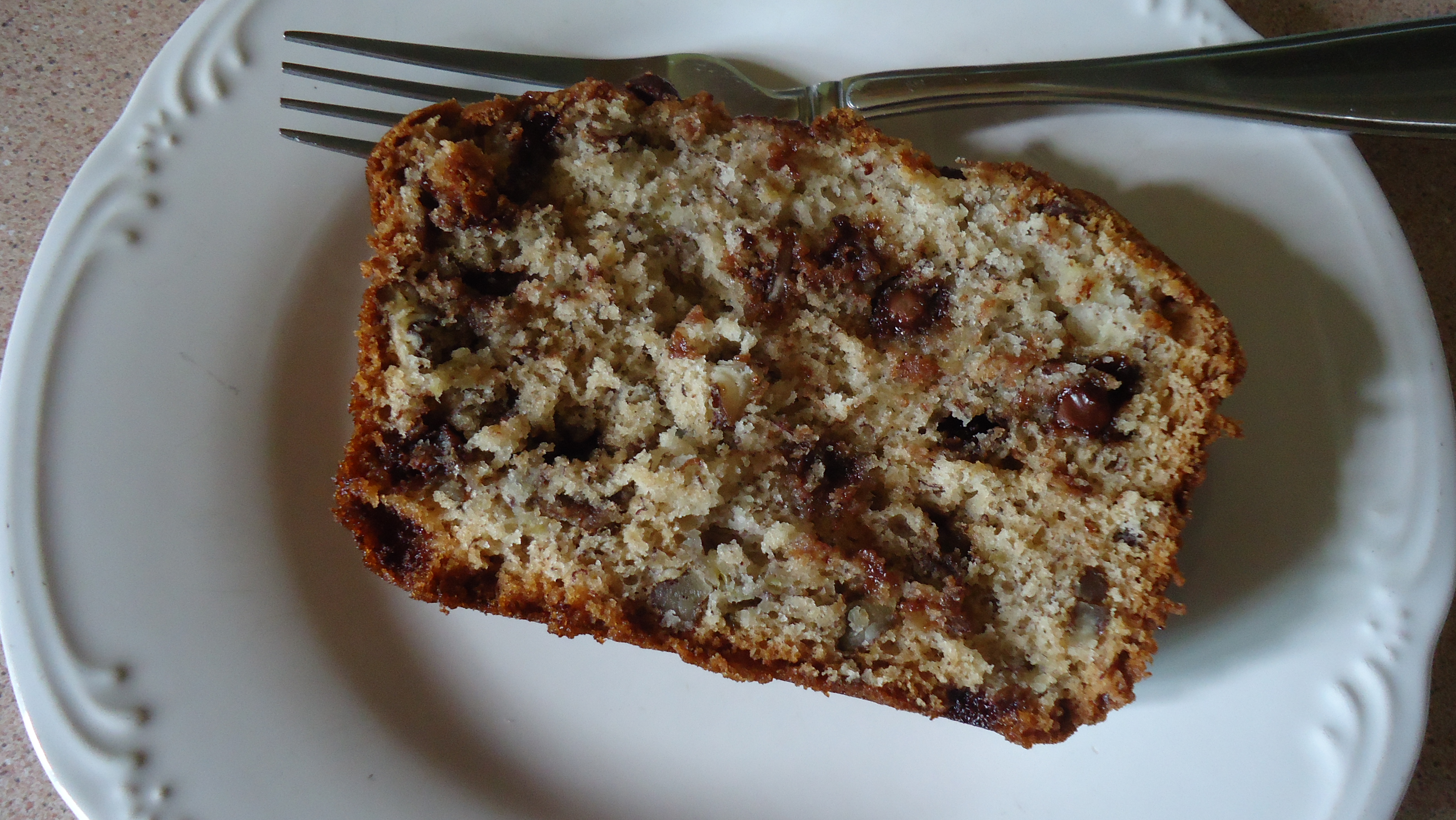
Some recipes are easy to embellish, and this recipe is one of those.  Take basic banana bread, add some nuts and chocolate chips, and you have a whole new treat.  I used pecans and milk chocolate chips, but you could certainly use walnuts and semi-sweet if you like.

I think one of the things that draws me to baking-other than the predictability of the outcome-is the possibility of creativity, and how there are endless ways to make a recipe more interesting.  Add flavoring to cake batter, and you change the cake.  Add nuts to brownie batter, and you change the brownie.  There’s something oddly liberating in that, in imagining the possibilities.

Ingredients

  • 1 1/2 cups flour
  • 1 1/2 teaspoons baking powder
  • 1/4 teaspoon baking soda
  • generous 1/4 teaspoon cinnamon
  • 1 egg
  • 3 medium very ripe bananas, mashed
  • 3/4 cup sugar
  • 1/4 cup vegetable oil
  • 1/2 cup chopped pecans
  • 1/2 cup milk chocolate chips

Preparation

Preheat oven to 350 degrees.

Grease an 8x4x2 loaf pan and set aside.

In a medium bowl, combine flour, baking powder, baking soda, and cinnamon.  Make a well in the center and set aside.

In another medium bowl, combine egg, mashed bananas, sugar, and vegetable oil.

Pour into flour mixture and stir until combined.

Add pecans and chocolate chips and stir to incorporate.

Pour into loaf pan and bake for 50-55 minutes, until a cake tester comes out clean.

Cool in pan or serve warm.

Buttermilk Chocolate Sheet Cake


Long before fondant dominated the Food Network and entire shows were dedicated to bakeries who could fashion cakes into realistic reproductions of Hogwarts Castle, there was the sheet cake.  The sheet cake is, for those who prefer not to spend more on a cake than they’d spend on a car payment, the go-to dessert for family or professional gatherings, celebrating birthdays, baby showers, graduations, and office farewells.

As far as I can tell, the world is divided into two groups of people: those who want the corner piece, and those who do not (much like those who want raisins in their oatmeal cookies, and those who do not).  We corner-piece folks cannot imagine why others prefer the cake to the frosting, for it is precisely the ample portion of frosting—on all three sides—that draws us to the corner piece in the first place.

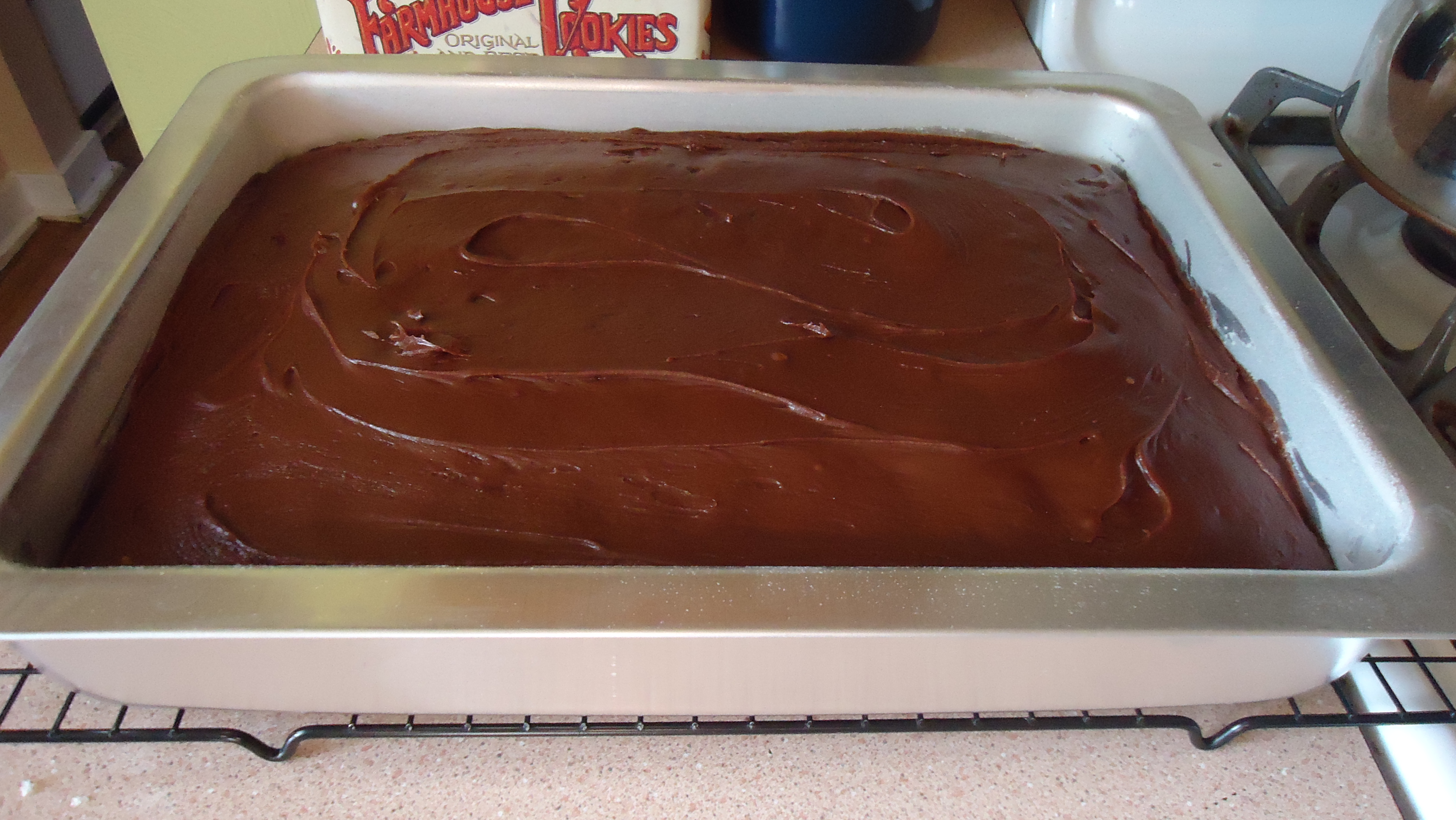
This recipe is also known as a Texas Sheet Cake and employs an interesting technique of cooking cocoa powder and butter for both the batter and the frosting, and by pouring the frosting over the cake while it is still warm.  The recipe can be baked in a 15x10x1 jelly roll pan for 25 minutes, but as I don’t have one of those (yet) I employed my 13x9x2 and it worked just fine.

Buttermilk Chocolate Cake

Ingredients

  • 2 cups flour
  • 2 cups sugar
  • 1 teaspoon baking soda
  • 1/4 teaspoon salt
  • 1 cup butter
  • 1/3 cup unsweetened cocoa powder
  • 1 cup water
  • 2 eggs
  • 1/2 cup buttermilk
  • 1 1/2 teaspoons vanilla extract

Preparation

Grease and flour a 13x9x2 sheet cake pan; set aside.

Preheat oven to 350 degrees.

In a mixing bowl, combine flour, sugar, baking soda, and salt.

In a medium saucepan, combine butter, cocoa powder, and water.  Cook, stirring constantly, until the mixture just comes to a boil.

Remove from heat and combine with dry ingredients, beating on medium speed until well-combined.

Add eggs, buttermilk, and vanilla and beat on medium speed for one minute.  Batter will be very thin.

Pour into prepared pan and bake for 35 minutes or until a cake tester comes out clean.

Just after the cake has come out of the oven, prepare the frosting so that it can be spread on the cake while the cake is still warm.

Buttermilk Chocolate Frosting

Ingredients

  • 4 tablespoons butter
  • 3 tablespoons unsweetened cocoa powder
  • 3 tablespoons buttermilk
  • 2 1/4 cups powdered sugar, sifted
  • 1 teaspoon vanilla extract

Preparation

In a medium saucepan, combine butter, cocoa powder, and buttermilk.

Cook on medium heat, stirring constantly, until mixture comes to a boil.

Remove from heat and vigorously stir in powdered sugar and vanilla until smooth.

Pour over warm cake and spread with a spatula.

Cinnamon Coffee Cake


In one of my favorite movies, Sense & Sensibility, Margaret Dashwood asks Colonel Brandon what it’s like in the East Indies.  He replies, as if imparting a great secret, “The air is full of spices.”

Whenever someone asks what that wonderful flavor is in a dish, it’s usually a spice.  Spices can be subtle, enhancing the flavors of other ingredients—the way pepper does, for example.  They can also be the main component, around which other ingredients are based, like in a cinnamon roll.

Cinnamon is a delightful aromatic spice that has been cultivated around the world for centuries.  I use Vietnamese cinnamon, which has a more complex flavor than your average grocery store-bought variety, but you can certainly bake with any kind.

From the moment this cake went into the oven, my kitchen was filled with the aromatic scent of cinnamon, and it lingered for hours after the cake was done.  The honey glaze is a surprising addition, offering a smooth, sweet flavor that complements the warm, spicy cinnamon cake.

For the streusel:

  • 1/4 cup packed brown sugar
  • 1/2 cup flour
  • 1 1/2 teaspoons cinnamon
  • 1/4 teaspoon salt
  • 3 tablespoons cold butter, cut into cubes

In a medium bowl, combine brown sugar, flour, cinnamon, and salt.

Cut in butter with a pastry blender (or two knives) until the mixture resembles small peas.

Place in the freezer until cake batter is ready.

For the cake:

  • 2 1/2 cups cake flour
  • 2 teaspoons baking powder
  • 1/2 teaspoon baking soda
  • 1/4 teaspoon cinnamon
  • 1/4 teaspoon nutmeg
  • 1/2 teaspoon salt
  • 12 tablespoons butter, room temperature
  • 1 1/2 cups sugar
  • 3 eggs, room temperature
  • 1 1/2 teaspoons vanilla extract
  • 1 1/4 cup sour cream

Spray a 10-inch tube pan with vegetable spray and line the bottom with parchment paper.

In a medium bowl, sift together flour, baking powder, baking soda, cinnamon, nutmeg, and salt; set aside.

Cream together butter and sugar until very light and fluffy.

Add eggs, one at a time, beating well after each.

Add vanilla and sour cream, beating until just combined.

With the mixer on low, add flour mixture in thirds until just combined, scraping the sides of the bowl as necessary.

Remove streusel mix from the freezer.

Spoon half the batter into the tube pan and spread evenly with a spatula; sprinkle 3/4 of the streusel mix over the top.

Spoon the remaining batter into the pan, spreading evenly with a spatula; sprinkle the remaining streusel mix on the top.

Bake for 50 minutes, until a cake tester comes out clean.

Place the pan on a wire rack to cool before drizzling with glaze.

For the honey glaze:

  • 2 cups powdered sugar
  • 3 tablespoons honey
  • 2 tablespoons water

In a small bowl, mix the powdered sugar, honey, and water together and stir until smooth.

If the glaze is too thick, add a small amount of water to thin it slightly; if the glaze is too thin, add a small amount of powdered sugar to thicken it.

Drizzle over cake.

Lemon Cupcakes


Ahh, lemons.  Fans of amy bakes in the ‘burgh know very well of my sincere appreciation of this sunny citrus fruit.  I’ve had a recipe for lemon cupcakes on my mind for a while now, and these are prepared with a simple lemon cream cheese frosting, but I look forward to experimenting with strawberry or raspberry cream cheese frosting in the future.

I don’t usually pipe my frosting, but these cupcakes seemed to request it.  I have big plans to buy a massive pastry bag and enormous plain tip the likes of which are seen on the Food Network, but for these I used a regular 12-inch pastry bag fitted with a #12 Ateco tip.  You could certainly embellish these cupcakes with sprinkles, colored sugar, or a bit of candied lemon peel, but I’ve gone the traditional route with a simple swirl of frosting.

Note: lemon curd can be made from scratch, but I used ready-made lemon curd that I found in the jelly and jam section of my grocery store.

Lemon Cupcakes

Ingredients

  • 2 1/2 cups flour
  • 2 1/2 teaspoons baking powder
  • 1/2 teaspoon salt
  • 12 tablespoons butter, slightly softened
  • 1 3/4 cups sugar
  • 1 1/2 teaspoons vanilla
  • 2 eggs
  • Zest of 2 medium lemons
  • 1 1/4 cups milk

Preparation

Preheat oven to 375 degrees.

Line two 12-inch muffin ups with paper liners; you will need additional liners, as this recipe yields about 30 cupcakes.

In a medium bowl, stir together flour, baking powder, and salt; set aside.

In a mixing bowl, cream together butter, sugar, and vanilla.

Add eggs, one at a time, beating well after each.

Add lemon zest and beat until combined.

Add flour mixture and milk alternatively, in three batches, beating until combined.

Using a cookie scoop, scoop batter into prepared muffin tins, filling about half full.

Bake for 18-20 minutes, until a cake tester comes out clean.

Cool completely before frosting.

Lemon Cream Cheese Frosting

Ingredients

  • 4 cups powdered sugar
  • 1/4 teaspoon salt
  • 4 tablespoons butter, softened
  • 4 ounces cream cheese, softened
  • 4 tablespoons shortening
  • 1/2 teaspoon vanilla extract
  • 1 tablespoon lemon juice
  • 2 tablespoons lemon curd
  • yellow food coloring

Preparation

In a large bowl, sift powdered sugar and salt together; set aside.

In a mixing bowl, cream together butter, cream cheese, shortening, and vanilla.

Add powdered sugar in four batches, beating well after each addition.

Add lemon juice and lemon curd and beat well.

Add several drops of yellow food coloring and beat well.

To frost:

Spoon frosting into a 12-inch piping bag fitted with a #12 Ateco tip.

Pipe frosting in a swirl on top of each cupcake.

Store in the refrigerator.

Devil’s Food Cake


Mike’s first “real” job as a newspaper reporter took us to LaPlata, Maryland.  After we moved there it took me a few months to find a job, so I spent the summer baking, sending the results of my confectionery endeavors in to his office.  This cake was a particular favorite, proclaimed by one of his colleagues to be worthy of a blue ribbon at the county fair.  Allegheny County doesn’t have a fair, but if it did, you can bet I’d enter this in it.

I’ve found that if you grease cake pans, then line them with waxed paper or parchment paper and grease the paper before flouring the pan, your cakes will pop out easily.  You can certainly use the traditional grease and flour method without the paper, but this is my preferred technique.  To make the liners, I place the paper down on a counter top, lightly trace its circumference with the tip of a knife, then cut a slightly smaller circle of paper to fit inside the pan.

Also, when I frost cakes, I always frost the sides last.  You can certainly frost the top last if you’d prefer, but I find that saving the sides for last makes a smoother edge where the side meets the top.  I’m not a huge fan of elaborate decorations on cakes, so I use an offset spatula and smooth strokes to create a very homemade, old-fashioned appearance. 

Ingredients


  • 2 1/4 cups flour
  • 1/2 cup unsweetened cocoa powder
  • 1 1/2 teaspoons baking soda
  • 1/4 teaspoon salt
  • 1/2 cup shortening
  • 1 3/4 cups sugar
  • 1 teaspoon vanilla
  • 3 eggs
  • 1 1/3 cups water
  • 1 recipe fudge frosting

Preparation

Preheat oven to 350 degrees.

Lightly grease two 9-inch round cake pans.  Line the bottom of each with waxed paper, lightly grease the waxed paper, and lightly flour each pan.

In a medium bowl, combine flour, cocoa powder, baking soda, and salt.  Mix well and set aside.

In a mixing bowl, beat shortening on medium speed for 30 seconds.

Add sugar and vanilla; beat until combined.

Add eggs, one at a time, beating until combined after each.

Add flour mixture and water alternatively in three batches, beating on medium speed until just combined.

Divide batter evenly between the pans and bake for 35 minutes, or until a cake tester inserted in the center comes out clean.

Cool in pans for about 10 minutes; run a knife around the edge of each pan to loosen the cakes, then turn them out onto cooling racks and remove the waxed paper from the bottom.  Flip right-sides up and allow to cool completely before frosting.


Iced Oatmeal Applesauce Cookies


Mike and I have been married for 12 years, and together for nearly 16.  We met at a frat party on the first night back for the fall semester at Frostburg State University in 1996 and have been together ever since, joking that we got married by default because it simply didn’t occur to us to look for anyone else.

Our tastes in food are drastically different, precipitating a number of challenges in the kitchen.  Mike will eat almost anything and seems to have a particular fondness for foods that make me gag, like sauerkraut, for example.  He also loves vegetables (even Brussels sprouts), puts condiments on everything, and enjoys chunky tomato sauce, chunky applesauce, and yogurt with fruit in it.  I would be perfectly happy eating peanut butter and jelly sandwiches for the rest of my life, I peel apples and peaches because I don’t like the skin, I believe the only accoutrements a sandwich or burger needs are cheese and well-done bacon, and I prefer my sauces and yogurts chunk-free.  Perhaps the greatest divide in our relationship is his fondness for raisins, as I cannot understand why shriveled grapes are appetizing.

Mike has three favorite cookies: chocolate chip, pecan rugelach, and these iced oatmeal applesauce cookies.  He’s had a busy week so far and will have an even busier weekend, so there are for him.

Ingredients

  • 4 tablespoons butter, melted
  • 1 cup packed brown sugar
  • 1/2 cup granulated sugar
  • 1 egg
  • 1/2 cup chunky applesauce
  • 1 1/2 cups rolled oats
  • 1 1/4 cups flour
  • 1/2 teaspoon baking soda
  • 1/4 teaspoon baking powder
  • 1/4 teaspoon kosher salt
  • 1 cup raisins

For the icing

  • 1 3/4 cups powdered sugar
  • 1 tablespoon vanilla
  • 2-3 tablespoons water

Preparation

Preheat oven to 350 degrees.

Line several sheets with parchment paper or foil.

In a mixing bowl, combine butter and sugars; beat on low speed until well-blended.

Add egg and applesauce; beat until very well-blended, about two minutes.

Add oats, flour, baking soda, baking powder, and salt; beat on low speed until combined.

Add raisins and stir by hand to incorporate.

Using a two-inch cookie scoop, drop cookies onto baking sheets about two inches apart; you should have six cookies per sheet.

Bake for 13-15 minutes, until golden brown.

Remove from oven and cool on baking sheets for about 5 minutes, then transfer to a wire rack to cool completely.

Combine powdered sugar, vanilla, and one tablespoon water.  Add additional tablespoons water, one at a time, until you reach a smooth, drizzly consistency.

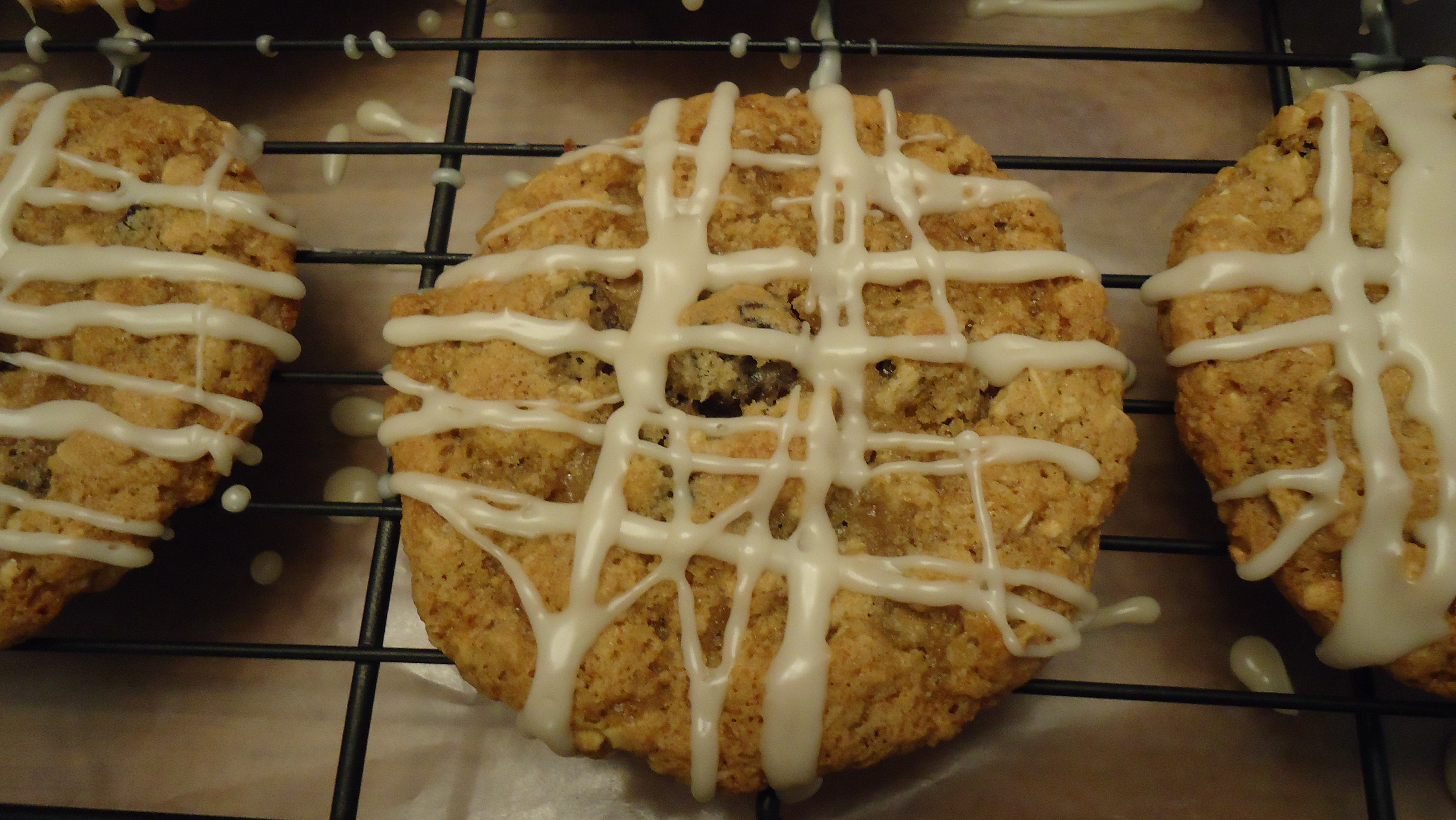
Channel your inner Jackson Pollock and drizzle icing over cookies.  Allow icing to set before storing.

Banana Oat Chocolate Chip Cookies


Bananas fare poorly in our kitchen.  Perhaps we have improper air flow, or really need one of those banana hanger gadgets.  Either way, before I know it even the greenest of bananas turn spotted and brown on our counter top.  When I pass them, I swear they whisper that I’m a bad hostess.

I once asked Mike if a particularly leopard-looking bunch was a nonverbal request for banana bread, to which he replied, “no, but if you wanted to make some that would be nice.”  I thought about making banana bread with our uber-ripe bananas tonight, but then I flipped through a cookie book and found a sticky note, left by Mike, on the page with this recipe.  I suspect that adding a bit of peanut butter to the batter would make them even more enticing, so stay tuned for Peanut Butter Banana Chocolate Chip Cookies in another post.

Ingredients

  • 1 1/2 cups flour
  • 1/4 teaspoon baking soda
  • 1/4 teaspoon salt
  • 12 tablespoons butter, slightly softened
  • 2/3 cup sugar
  • 1/3 cup light brown sugar
  • 1 egg
  • 2 teaspoons vanilla extract
  • 1/2 cup thoroughly mashed very ripe banana (2 small bananas or 1 medium banana)
  • 1 cup old-fashioned oats
  • 1 cup milk chocolate chips

Preparation

Preheat oven to 350 degrees

Line several baking sheets with foil and spray with cooking spray.

In a medium bowl, stir together flour, baking soda, and salt; set aside.

In a mixing bowl, cream together butter and sugars.

Add egg and vanilla and beat well.

Add flour mixture and banana and beat until combined.

Stir in oats and chocolate chips until well combined.

Using a two-inch cookie scoop, drop cookies onto prepared baking sheets about two inches apart; you should have six cookies per sheet.

Bake for 12-14 minutes, until light golden brown all over and centers are almost firm when pressed.

Transfer baking sheet to a wire rack and allow to stand for 2-3 minutes to firm up slightly.

Transfer cookies from the baking sheet to another wire rack to cool completely.

Blackberry Cobbler


Happy Independence Day!   Let’s take a moment to express our sincere thanks to the men and women of the United States military for protecting our freedom and for their bravery, selflessness, and sacrifice.

Being an American is pretty awesome, no matter what anyone says about politics.  We have a beautiful country with a diverse landscape and ample natural resources.  We have freedom of speech, the press, and religion.  We have the right to vote.  We have access to education.  We have choices, and we have hope.  Those are amazing gifts, and not one of us should take them for granted.

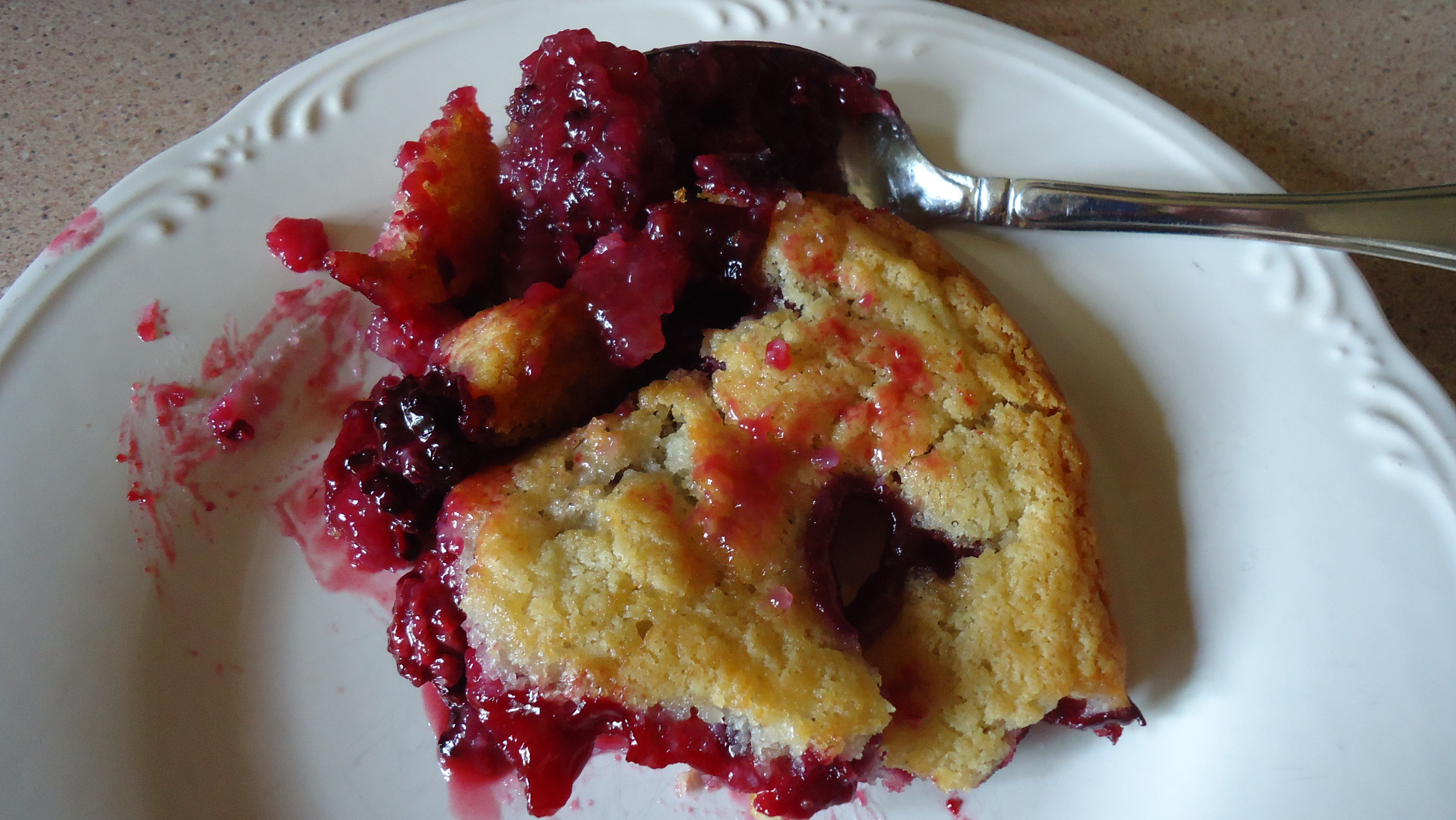
In celebration of Independence Day, I wanted to make a traditional American dessert.  Since the blackberry bushes in our yard yielded an impressive crop in the past few days, Mike suggested blackberry cobbler.  Cobbler originated in the British American colonies, where settlers lacked the ingredients and equipment they needed for English desserts.  To remedy this, enterprising colonial women combined uncooked biscuit dough or dumplings with stewed fruit, and cobblers were born.  Cobblers are so named not only because they resemble a cobbled street when baked, but also because their ingredients were quite literally cobbled together.

Mike, a veteran of the Maryland Army National Guard, proclaimed this cobbler excellent.

Ingredients

  • 2 1/2 cups blackberries
  • 1 cup sugar
  • 1 cup flour
  • 2 teaspoons baking powder
  • 1/2 teaspoon salt
  • 1 cup milk
  • 1/2 cup butter, melted

Preparation

Rinse blackberries well and place in a medium bowl.  Add sugar, mix well, and let stand for about 20 minutes, mixing occasionally to distribute the sugar evenly.

Preheat oven to 375 degrees.

In a large bowl, combine flour, baking powder, salt, and milk; mix well.

Add melted butter; mix very well.

Pour batter into an ungreased 8-inch baking dish.

Spoon berry/sugar mixture over the top.

Bake for 45-50 minutes, until the dough rises and turns golden brown.

Serve warm or let cool; add a scoop of vanilla ice cream or fresh whipped cream if you like.

Steamed Crab Sugar Cookie Cut-Outs with Vanilla Icing


The Great State of Maryland has played a huge role in my life.  My mom was born and raised there, and I chose Frostburg State University for college, married a Maryland boy, and lived there for a while before moving to DC.

Marylanders are proud of the Chesapeake Bay, its history, and its industry.  Mike can tell you, in great detail, about the pollution that led to a serious reduction in the crab and oyster populations in the 1980s, precipitating the “Save the Bay” initiative. Fortunately, Marylanders are environmentally-minded, and the bay is now a healthy source of tasty seafood, the most famous of which is the blue crab.

Crab feasts are social events, involving iced tea, beer, Old Bay, newspaper-covered picnic tables, and epic storytelling.   They last for hours and hours.  I had never eaten a crab until I met Mike, and his dad taught me how to whack the shell open with a mallet and extract the meat with a knife.  I admit that I had the patience for one crab-whacking only; to this day, I prefer my crab in cake form.

These crab cookies are dedicated to all of my favorite Marylanders.

You will need:

  • A crab-shaped cookie cutter
  • One double batch of Sugar Cut-Outs
  • One batch vanilla icing (see below)
  • Red and brown gel paste food coloring

Vanilla Icing

Ingredients

  • 6 tablespoons shortening
  • 2 egg whites
  • Pinch of salt
  • 4 cups powdered sugar
  • 2 teaspoons vanilla extract
  • 1-2 teaspoons water

Preparation

Combine shortening, egg whites, salt, and 1 cup powdered sugar in a mixing bowl.  Beat well on medium speed for about one minute.

Add one cup of powdered sugar at a time, beating well on medium, then high speed for about one minute after each.

Add vanilla extract and beat well; if you want a thinner consistency, add one to two teaspoons of water and beat very well.

To create cookies:

Reserve a small portion of the icing to tint brown for eyes; tint remaining icing red.

Frost crab bodies red, then pipe on eyes.

Let icing harden for a few hours before storing; store between sheets of waxed paper in an airtight container.